



Klarna sells a $40 unlimited 5G plan. Revolut offers mobile plans with roaming across the EU and US. Nubank built travel eSIM access into a premium cardholder benefit. None of these companies are carriers. They are fintechs that decided connectivity belongs inside their product, and they launched in weeks.
That is the 2026 reality for anyone learning how to launch an MVNO in the US. The barrier to entry has collapsed. The US MVNO market is expected to reach $46.76 billion in 2026 and $64.69 billion by 2031 at a 6.71% CAGR, according to Mordor Intelligence. North America is now the fastest-growing MVNO region worldwide at a projected 10.12% CAGR. Cloud-based MVNO platforms are expanding at nearly 13% CAGR. IoT MVNO lines are growing at almost 17% per year.
If you are an OEM, a retailer, a fintech, an IoT platform, or a founder building in a vertical the big carriers cannot serve well, this guide walks you through the full launch, from business model selection and FCC registration to eSIM provisioning, 5G network slicing, and the deployment timeline.
- Timeline: Light MVNO via an MVNE can go live in 7 to 90 days. Full MVNO builds take 6 to 18 months.
- Cost: Modern MVNE routes start in the low thousands. Traditional Light MVNO builds range from $100K to $400K. Full MVNO deployments range from $2M to $10M+.
- Models: Branded Reseller, Light MVNO, Service Provider MVNO, Full MVNO, Embedded Telco, IoT MVNO.
- Key Compliance: FCC Form 499-A, USAC contributions, Kari’s Law, RAY BAUM’s Act, CALEA, CPNI, Section 214 for international services.
- Fastest Path: Partner with an MVNE that provides multi-carrier access, eSIM provisioning, billing, and compliance through a single API.
Why 2026 Is the Inflection Point for US MVNOs
The MVNO model is no longer a discount niche. Three shifts in 2025 and 2026 redefined the space:
- 5G standalone matured. Global 5G connections crossed 2.6 billion in 2025, growing 37% year on year. Over 90 operators launched standalone 5G across 42 countries. That unlocked network slicing, so MVNOs can now sell differentiated tiers for gaming, IoT, or enterprise instead of just cheaper voice and data.
- eSIM went mainstream. ABI Research projects 633 million eSIM-enabled device shipments in 2026. Every iPhone sold in the US is eSIM only. Juniper Research forecasts 1.5 billion eSIM connections globally by the end of 2026. Activation times dropped by over 90% compared to physical SIM shipping.
- Embedded Telco became a category. Fintechs, retailers, airlines, and device makers now launch mobile services as a feature of the parent product.
The companies winning in this market are not trying to be the next Mint Mobile. They are wrapping branded connectivity around a core product that already has distribution, and they are doing it with cloud-native MVNE platforms instead of building telecom stacks from scratch.
The 6 MVNO Business Models: Which One Fits You?
Picking the right model is the single most important decision you will make before you ever talk to a carrier. Each step up the ladder gives you more control over the subscriber experience and margin, but also demands more capital, telecom expertise, and regulatory surface area.
| Model | What You Own | Time to Launch | Typical Investment | Best For |
|---|---|---|---|---|
| Branded Reseller (Skinny MVNO) | Brand, marketing, limited pricing | 2 to 4 weeks | $10K to $100K | Retailers, affinity brands, diaspora |
| Light MVNO | BSS, CRM, billing logic | 2 to 4 months | $100K to $400K | Digital-native startups |
| Service Provider MVNO | Customer ops, distribution, plans | 3 to 6 months | $250K to $1M | Niche consumer brands |
| Full MVNO | Core network (HLR, HSS, IMSI) | 9 to 18 months | $2M to $10M+ | Carrier-grade operators, global plays |
| IoT / M2M MVNO | Device SIM profiles, APNs, policy | 1 to 4 months | $50K to $500K via MVNE | OEMs, fleets, smart devices |
| Embedded Telco MVNO | In-app provisioning, API layer | 4 to 8 weeks | Revenue share with MVNE | Fintechs, superapps, marketplaces |
One structural shift worth calling out: the Full MVNO segment held 57.83% of global MVNO revenue in 2025, up sharply from five years earlier. The market now rewards operational depth. If your value proposition is just a cheaper voice bundle, you will be squeezed on both ends. If you own a vertical or a customer base the big carriers cannot serve well, depth pays.
For a deeper comparison, see our full breakdown of MVNO types and use cases.
How Much Does It Cost to Launch an MVNO in the US?
Short answer: a Light MVNO launched through a modern MVNE starts in the $10K to $400K range for first-year costs. A Full MVNO with owned core infrastructure can run $2 million to $10 million or more before you ever bill a subscriber. The difference is almost entirely about what you build versus what you license.
Cost Breakdown by Category
| Cost Category | Traditional Build | MVNE-Powered Launch |
|---|---|---|
| Network access (wholesale) | Volume commitments, $500K+ minimums | Pay-as-you-grow, no minimums |
| BSS / OSS / billing platform | $500K to $2M to build | Included in platform fee |
| SIM / eSIM provisioning | $150K to $500K infrastructure | API-based, per activation |
| FCC and tax compliance | $75K to $250K setup + counsel | Handled by MVNE or carrier of record |
| Customer support tools | $100K to $300K | Included or modular add-on |
| Fraud and analytics | $50K to $200K | Included |
| Marketing and acquisition | $50 to $150 CAC | $50 to $150 CAC (unchanged) |
| First-year total | $5M+ typical | $10K to $400K |
For a fuller treatment of infrastructure-driven pricing and how modern platforms shift cost from CapEx to OpEx, see How Much Does It Cost to Launch an MVNO?.
The 10-Step Playbook to Launch an MVNO in the US
This is the sequence that works in 2026. Each step compresses when you work through an MVNE, and each one tends to blow up budgets when skipped.
Step 1: Define Your Ideal Customer Profile and Value Proposition
Every MVNO begins with a problem-solution fit, not a price cut. Narrow your ICP to a segment the hyperscale carriers cannot serve well: price-sensitive retail buyers, gig workers needing flexible data, seniors who want simplified plans, narrowband IoT devices, global eSIM travelers, or vertical fleets like healthcare, logistics, or retail. Map the segment to technical needs: coverage footprint, latency, average throughput, device interoperability, pooled versus unpooled data, and roaming behavior.
Step 2: Pick Your MVNO Model
Use the model comparison table above. If this is your first telecom launch and the goal is embedded connectivity inside an existing product, start with Branded Reseller or Light MVNO and upgrade later. If you need deep SIM control, your own IMSI range, or carrier-grade independence, plan for Full MVNO from the start.
Step 3: Select Your Host Network (MNO)
The US market runs on three MNOs: AT&T, T-Mobile, and Verizon. Each has different wholesale commercials, coverage strengths, IoT APN support, eSIM readiness, and 5G network slicing maturity.
- AT&T: Strong rural and enterprise IoT posture. SurgePays signed a multi-year 5G MVNO deal with AT&T in late 2024 specifically for rural coverage.
- T-Mobile: Strong 5G standalone and mid-band footprint. Launched SIM-based SASE with dedicated network slices for zero-trust enterprise security in 2025.
- Verizon: Largest postpaid base, strong coverage, widely used by premium MVNOs like Visible and Visible+.
Multi-carrier setups are increasingly standard for serious launches. Platforms like Spenza give you authorized access to all three US carriers plus 40+ global operators through a single contract and a single API, so you are not locked in, and you can route traffic based on coverage, cost, or SLA.
Step 4: Choose Your MVNE Partner
This decision shapes your unit economics, time to market, and operating rhythm more than any other. An MVNE (Mobile Virtual Network Enabler) gives you a pre-integrated stack: wholesale connectivity, BSS/OSS, eSIM platform, billing, compliance tooling, and analytics. Evaluate MVNEs on the following:
- Multi-operator access: can you source plans from more than one US carrier and across geographies?
- eSIM and physical SIM support, with remote provisioning and GSMA SGP.32 readiness for IoT
- API depth: SIM lifecycle, subscription management, billing events, usage analytics
- Billing flexibility: prepaid, postpaid, pooled, usage-based, bundled, B2B invoicing
- Compliance coverage: FCC registration, USF contributions, CPNI, Kari’s Law, RAY BAUM’s Act, state taxes
- White-label capabilities: branded apps, self-serve portals, Shopify-ready checkout
- Commercial model: flat platform fee versus revenue share versus pay-per-event
For a full evaluation framework, see MVNE vs MVNA vs MNO: which is best for launching your MVNO.
Step 5: Handle FCC and State Regulatory Compliance
US compliance is workable but unforgiving. If your MVNE acts as the carrier of record, most of this runs through them. If you are going independent, here is the core list:
| Requirement | What It Is | When It Applies |
|---|---|---|
| FCC Form 499-A | Annual telecom revenue filing with the FCC and USAC | All US telecom providers |
| FCC Form 499-Q | Quarterly revenue reports | All US telecom providers |
| USF contributions | Universal Service Fund, safe harbor at 64.9% of wireless revenue | All interstate services |
| Operating Company Number (OCN) | Identifier for carrier interconnection | Most MVNOs |
| CALEA compliance | Lawful intercept support under Communications Assistance for Law Enforcement Act | All US voice and data carriers |
| CPNI protection | Customer Proprietary Network Information safeguards | All US carriers |
| Kari’s Law | Direct 911 dialing and notification | Any MLTS-style service |
| RAY BAUM’s Act Section 506 | Dispatchable location for 911 calls | All 911-capable services |
| FCC Section 214 | Authorization for international services | If you offer international termination |
| State-level USF and 911 fees | Varies by state | Depends on where subscribers live |
| TCR / 10DLC registration | Brand and campaign registry for A2P SMS | If you send application-to-person SMS |
Authoritative references: FCC Form 499, Kari’s Law and RAY BAUM’s Act, and USAC contribution reporting.
Step 6: Build or License Your Technology Stack
Four systems carry the operational load. Build any one of these from scratch and your timeline stretches by months.
- BSS (Business Support System): billing, plan lifecycle, top-ups, invoicing, taxes, payments, and revenue recognition. Real-time rating is table stakes in 2026.
- OSS (Operations Support System): SIM provisioning, service activation, APN configuration, network integration, fault and performance monitoring.
- eSIM / SIM platform: consumer remote SIM provisioning (SGP.22), IoT remote SIM provisioning (SGP.32), profile download via QR, and eSIM transfer flows.
- Analytics and fraud: real-time ARPU, churn, usage patterns, anomaly detection for SIM cloning and abnormal data bursts.
Operators on Spenza get this stack pre-integrated with a unified dashboard, which is why launches compress to days. For a technical deep dive, see our MVNO billing platforms guide.
Step 7: Design Plans, Pricing, and Commercial Logic
Pricing is where positioning becomes math. In 2026, the winning plan structures reward specificity over breadth. A few patterns that work:
- Tiered unlimited for consumer, with premium tier removing data deprioritization (Visible+, US Mobile Premium)
- Pooled data with shared buckets for fleets and enterprise IoT
- Per-device or per-endpoint pricing for OEMs embedding connectivity in hardware
- Travel eSIM as an add-on or cardholder benefit, as Nubank and Revolut do
- Bundled plans with OTT content, cloud storage, or gaming passes. Bundled plans are the fastest-growing MVNO pricing segment, projected at 9.2% CAGR from 2026 to 2035.
Step 8: Set Up Customer Support, Distribution, and Activation
Three decisions here: who handles support, how customers buy, and how they activate. Digital-only onboarding is now the dominant channel, with digital-only sales representing nearly half of US MVNO subscriber additions. For support, AI agents that actually execute actions (refunds, plan changes, SIM swaps) are replacing chatbots as the first line of contact in 2026. For distribution, embedded checkout inside your primary product or a Shopify storefront is faster to launch than a standalone store. Activation through eSIM QR cuts first-month churn significantly compared to physical SIM shipping.
Step 9: Launch, Stress Test, and Go Live
Run end-to-end tests across the full subscriber lifecycle before you open the gates: port-in, eSIM activation, plan changes, overage handling, invoice generation, 911 tests, SMS delivery, international roaming if relevant, and fraud triggers. Soft launch to a small cohort first, watch churn signals for two to four weeks, then open wider. Most Light MVNOs need clean data across 500 to 2,000 early subscribers to know their billing and support are stable.
Step 10: Scale With Data, Automation, and Vertical Depth
Post-launch the game changes. The top-quartile MVNOs in 2026 run tight feedback loops between usage data and plan design, automate 60 to 80% of support tickets, and invest in vertical depth rather than broad discounting. Operators that stay broad get squeezed. Operators that own a vertical, whether that is fleet connectivity, gaming, healthcare IoT, or fintech-native plans, expand both ARPU and retention.
Realistic US MVNO Launch Timeline
Timeline depends entirely on your model and whether you work through an MVNE. Here is a realistic planning view for 2026.
| Phase | Activities | MVNE-Powered Light MVNO | Full MVNO (Independent) |
|---|---|---|---|
| Plan and scope | ICP, model, commercials, compliance scoping | Week 1 | Month 1 to 2 |
| Vendor selection | MNO contract, MVNE, billing, tax engine | Week 2 | Month 2 to 5 |
| Compliance and registration | FCC 499, OCN, state filings, CALEA, CPNI | Week 3 | Month 3 to 6 |
| Integration and build | BSS, OSS, eSIM, APIs, checkout, support | Week 4 | Month 5 to 12 |
| Testing and soft launch | Port-in, activation, billing QA, 911 test | Week 5 | Month 12 to 15 |
| Public launch | Marketing, acquisition, scale operations | Week 6 onward | Month 15 to 18 |
For a branded reseller or Light MVNO on a modern MVNE, a focused team can move from contract signed to first paying subscriber in as little as 7 to 30 days. This is especially true when you skip custom branding cycles and use a pre-built white-label checkout.
Spenza-powered operators have launched in as little as 7 days using a combination of carrier plan marketplaces, no-code plan builders, and Shopify-based distribution.
Key Technology Decisions for 2026 and Beyond
1. eSIM: Default, Not Optional
The US is effectively eSIM-first. Apple ships iPhones in the US as eSIM only. Juniper Research projects 1.5 billion eSIM connections globally by end of 2026. 80% of new vehicles in North America are expected to incorporate eSIM for telematics by 2026. Any MVNO launch plan that treats eSIM as a phase-two feature will lose early revenue. SGP.32 is the GSMA standard for IoT eSIM, enabling push-based bulk provisioning, which matters for fleets and device OEMs.
2. 5G Standalone and Network Slicing
Nationwide 5G standalone deployments have closed most of the performance gap between MVNOs and direct MNO customers. More importantly, network slicing lets MVNOs sell differentiated tiers that were previously impossible. T-Mobile’s SIM-based SASE launch with dedicated network slices is the template. Gaming, AR, healthcare, and private 5G are the likely near-term slicing use cases. If your MVNO targets a latency-sensitive or security-sensitive vertical, slice access should be in your MNO commercial terms from day one.
3. Satellite and Non-Terrestrial Networks
Satellite / NTN services are the fastest-growing US MVNO technology segment, projected at 63.2% CAGR through 2031. For use cases like rural IoT, asset tracking, maritime, and emergency connectivity, plan for satellite fallback in your coverage and routing logic.
4. AI-Native Operations
In 2026, AI agents connect directly to BSS/OSS and execute multi-step actions on behalf of customers: diagnosing outages, issuing refunds, provisioning temporary profiles, and optimizing plan selection. For MVNOs, this is both a cost lever and a retention lever. MobileX uses AI to recommend optimal plans based on actual usage patterns. The operators investing in AI-driven support and plan optimization now will have meaningfully lower support cost per subscriber within twelve months.
Common Risks and How to Avoid Them When Launching an MVNO
| Risk | Why It Matters | Mitigation |
|---|---|---|
| Underestimating compliance cost | FCC, USAC, CALEA, and state filings stack fast | Use MVNE as carrier of record, or budget $75K+ for counsel |
| Single-carrier lock-in | One MNO price hike compresses margins | Negotiate multi-carrier setup from day one |
| Weak churn design | Consumer MVNO monthly churn runs 3 to 5% | Invest in onboarding, plan optimization, and bundling early |
| Building BSS/OSS from scratch | Adds 6 to 12 months and $500K+ | License a proven MVNE platform |
| Treating eSIM as phase 2 | Loses early adopters and activation speed | Launch eSIM alongside physical SIM on day one |
| Ignoring CAC fundamentals | CAC can exceed LTV if unit economics are off | Model ARPU, gross margin, and payback before launch |
| No fraud controls | SIM farms and usage abuse drain margin | Use platform-level fraud detection from launch |
Case Studies: US MVNO Launches That Worked
Angel Watch: Scaling Smart Wearables with eSIM
Angel Watch, a maker of children’s safety smartwatches, needed flexible, affordable connectivity with wide coverage. Partnering with Spenza let them build low-bandwidth IoT plans, sell bundled device-plus-plan offers directly through Shopify, and expand into global markets without stitching together individual carrier contracts. The launch went from concept to live sales in weeks rather than quarters.
IMZ: Nationwide Wireless Without Owning a Core
IMZ, a US-based technology company, wanted to add a branded nationwide wireless offering without negotiating standalone MNO deals or building billing from scratch. Using Spenza’s operator-neutral platform and Bring Your Own Network capability, IMZ supported both physical SIMs and eSIMs under a unified brand, launched in under 30 days, and avoided the capital intensity of traditional MVNO setups.
How Spenza Helps You Launch an MVNO in the US
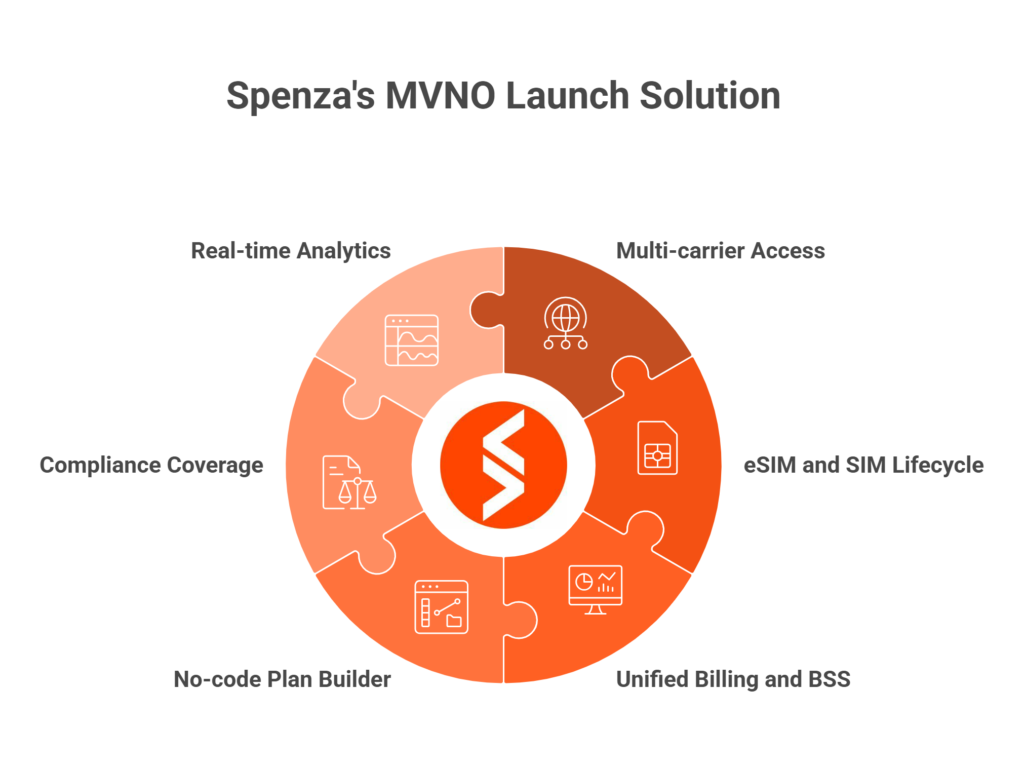
Spenza is an operator-neutral, API-first MVNE built for companies that want branded connectivity without becoming a telecom company. As an authorized reseller of AT&T, Verizon, T-Mobile, and 40+ global operators, Spenza handles the parts of an MVNO launch that usually consume the first twelve months.
- Multi-carrier access: Single contract, single API, connectivity across all three US MNOs and 600+ networks in 190+ countries.
- eSIM and SIM lifecycle: SGP.22 and SGP.32 support, QR-based onboarding, dynamic profile switching, bulk provisioning for IoT.
- Unified billing and BSS: Real-time rating, prepaid and postpaid, usage-based and pooled plans, automated invoicing, and payouts to operators.
- No-code plan builder: Launch new plans in minutes, test pricing mixes, and publish to a white-label marketplace or Shopify store.
- Compliance coverage: FCC registration support, USF, CPNI handling, Kari’s Law and RAY BAUM’s Act readiness through certified carrier partners.
- Real-time analytics: Subscriber, ARPU, usage, and churn signals in a single dashboard across carriers and regions.
- Connected device OEMs embedding branded SIMs or eSIMs into hardware
- MSPs and resellers adding mobile to an existing IT or broadband stack
- Fintechs and consumer platforms launching embedded mobile plans
- Retailers and affinity brands turning an audience into a subscription business
- Enterprises moving fleet, field, or logistics connectivity off fragmented contracts
If your launch plan includes more than one carrier, more than one country, or more than one product segment, you should not be building that stack in-house. Talk to Spenza and see what the first 30 days of your MVNO could look like.
Your Next Step
The 2026 US MVNO opportunity is not evenly distributed. It rewards focus, speed, and operational depth. If you have a distribution channel, a customer base, or a vertical the major carriers cannot serve well, the economics work. The slow, expensive path of building your own core and negotiating directly with MNOs is no longer the default. A modern MVNE like Spenza collapses the timeline, handles compliance, and gives you a real shot at going live in weeks instead of years.
FAQs
Need to start fast and scale without heavy infrastructure? Talk to Spenza. We’ll help you go live without guesswork.


