


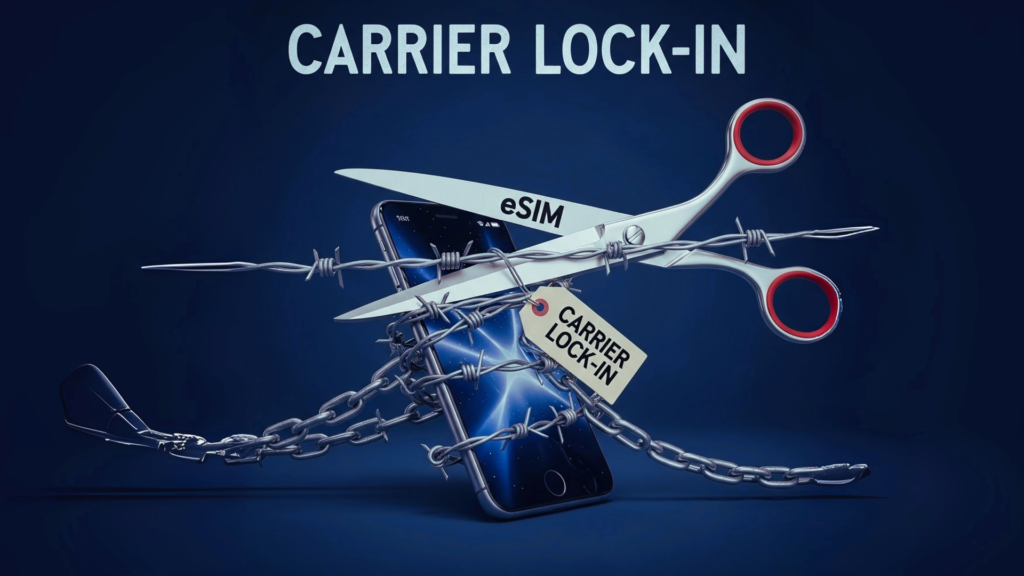
What Is IIoT Carrier Lock-In?
IIoT carrier lock-in occurs when industrial devices depend on a single mobile operator for connectivity throughout their lifecycle, making it difficult to change networks because of fixed SIMs, contracts, coverage limitations, or operational constraints.
Where Lock-In Bites (4 Industrial Use Cases)
- Smart Metering: 10–15 year lifecycles collide with network sunsets and price changes. A 3G/4G-only meter can be stranded mid-life if the network is refarmed, requiring costly field swaps.
- Remote Tank Monitoring: Remote locations + patchy coverage. Single-MNO devices go dark in dead zones; eSIM can fail over to a stronger local MNO.
- Industrial Pumps/HVAC: Hard-to-reach installs (rooftops, ceilings). Any SIM change equals a truck roll and multiplied across thousands.
- Connected Generators: Long service life + evolving bands/LPWAN variants (LTE-M/NB-IoT). Without profile agility, you’re stuck on “yesterday’s network.”
The Hidden Costs of Carrier Lock-In
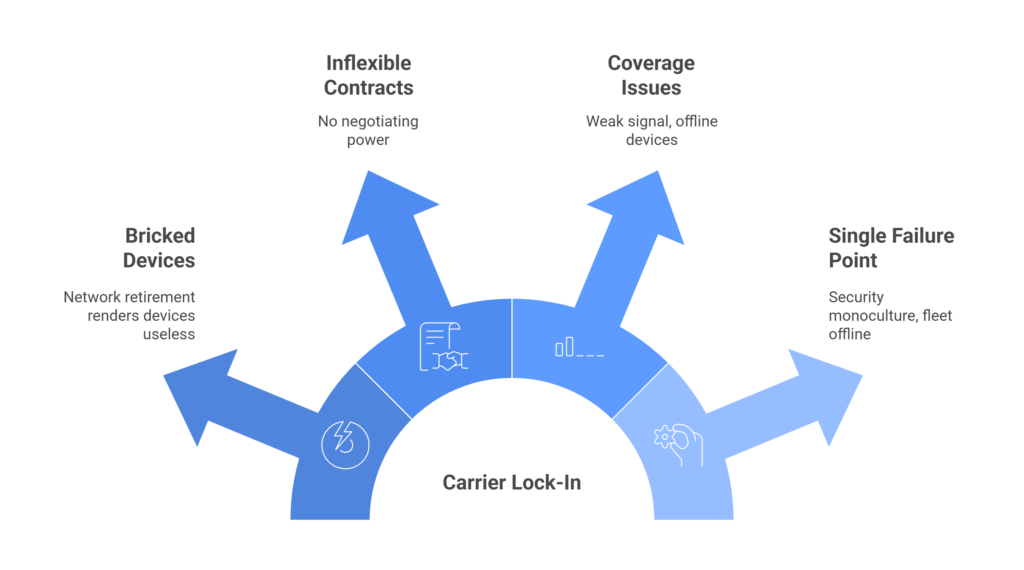
When your industrial devices are tied to a single carrier with a physical SIM card, you’re exposed to serious risks that can cripple your operations and budget. Here’s what that means in simple terms:
1. Your Devices Can Become Expensive Paperweights
Carriers eventually shut down older networks (like 3G and 4G) to make way for newer ones. If your device has a 15-year lifespan but is locked to a 4G network, it becomes a useless “bricked” asset when that network is retired in year eight.
Your only option is an incredibly expensive mission to physically replace the SIM in every single device.
2. You’re Trapped in Costly, Inflexible Contracts
Once your devices are deployed in the field, you lose all negotiating power. You’re stuck with your carrier’s pricing for the life of the asset, even if they raise rates or more competitive offers become available.
Furthermore, if your devices need to operate in different regions, you’re forced to rely on complex and expensive roaming agreements.
3. You’re at the Mercy of One Carrier’s Coverage
No single carrier provides 100% perfect coverage everywhere. If your devices are in an area where your chosen provider has a weak signal, they simply go offline, leading to unreliable data and operational gaps.
Resolving these issues often requires dispatching technicians to remote sites, a costly process known as a “truck roll“.
4. Your Entire Fleet Shares a Single Point of Failure
Relying on one network for all your devices creates a security “monoculture“. If that single carrier experiences a technical outage or a cyberattack, your entire fleet of devices could be knocked offline simultaneously. This concentrates all your operational risk in one basket, which can have devastating consequences.
It might feel a bit panic-inducing to realize how stuck you are with your current carrier but the good news is, there’s a way out: eSIM and Remote SIM Provisioning (RSP) are changing the game.
The Solution: How eSIM and Remote SIM Provisioning (RSP) Break the Chains
In response to these limitations, the industry developed the embedded SIM (eSIM). Unlike a removable plastic SIM card, an eSIM for IIoT is a rugged, built-in chip inside industrial devices that can store multiple mobile carrier profiles.
The real magic? These profiles can be switched remotely, over the air, without ever needing physical access, making it ideal for machines deployed in hard-to-reach or global locations.
The real innovation lies in two related concepts:
- eUICC(Embedded Universal Integrated Circuit Card): This is the secure software on the eSIM that can store multiple operator profiles at once. Think of it as a digital wallet for network identities.
- Remote SIM Provisioning (RSP): This is the globally standardized process for remotely managing the profiles on the eUICC over-the-air (OTA). It’s the engine that allows you to add a new carrier, switch between carriers, or remove a profile from any device, anywhere in the world.
You get carrier choice, multi-profile resilience, single global SKU, and “no-truck-roll” lifecycle ops.
eSIM vs. Multi-IMSI: What Is the Difference?
eSIM/eUICC and Multi-IMSI solve carrier flexibility in different ways.
- eSIM/eUICC: Stores operator profiles on an embedded secure element and enables remote profile provisioning and management.
- Multi-IMSI: Allows multiple mobile identities to be associated with a SIM/eSIM and can support connectivity across different networks, depending on the provider architecture.
- eSIM + RSP: Makes it possible to remotely manage operator profiles without physically replacing the SIM.
- Multi-carrier connectivity: Uses the available profiles, identities, or network relationships to provide greater carrier choice and resilience.
For long-life IIoT deployments, the right architecture depends on device capabilities, target countries, operator support, roaming requirements, and the level of control required by the enterprise.
Why the GSMA SGP.32 Standard is a Game-Changer
The GSMA SGP.32 specification defines an eSIM IoT architecture for remote provisioning and management of eUICCs in network- and/or user-interface-constrained IoT devices. It introduces the eSIM IoT Manager (eIM) as a key component for managing profiles across IoT deployments.
SGP.32 does not automatically eliminate carrier dependencies or guarantee network switching. Its value is providing a standardized architecture for remotely managing operator profiles, which can give enterprises greater flexibility when the device, profile provider, and participating operators support the required ecosystem. The current GSMA specification is SGP.32 v1.3.
This change finally delivers on the promise of true carrier independence.
The Tangible Business Benefits of an eSIM-First Strategy
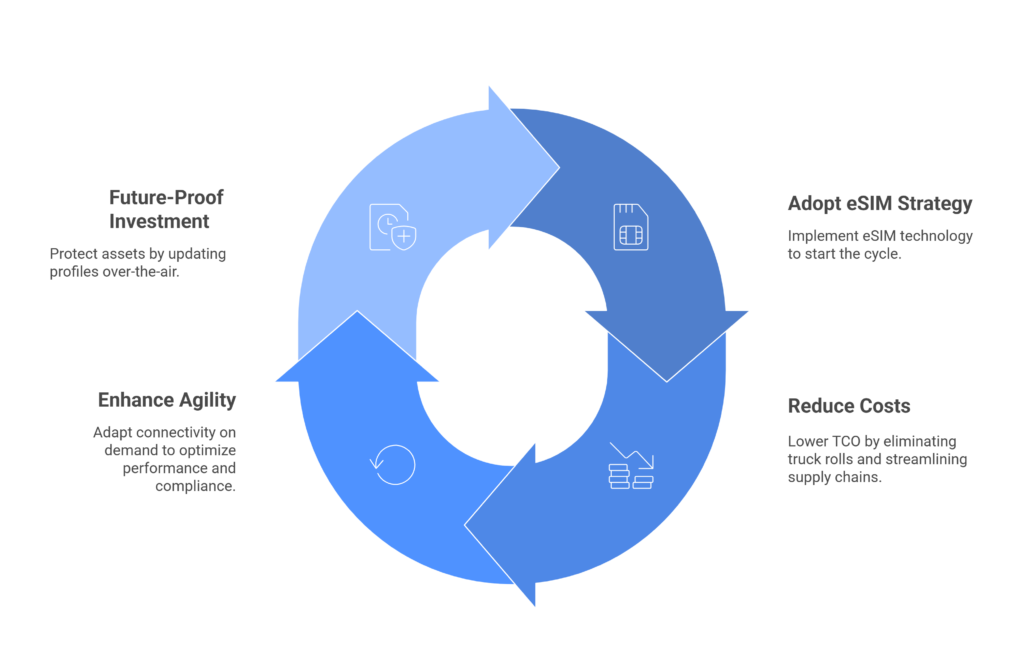
Adopting an eSIM-first strategy, governed by the SGP.32 standard, translates directly into powerful business advantages.
1. Radical Cost Reduction: Transforming your Total Cost of Ownership (TCO)
While an eSIM component may have a slightly higher upfront cost, the long-term TCO savings are immense. You can eliminate costly truck rolls for all connectivity-related issues and streamline your supply chain by manufacturing a single global SKU of your product, downloading the correct local carrier profile at the time of deployment.
2. Unprecedented Agility: Adapting Connectivity on Demand
eSIM transforms connectivity from a fixed attribute into a flexible resource. You can remotely switch carriers to optimize for better coverage, more competitive pricing, or higher performance. This also allows you to seamlessly adapt to changing international regulations, such as bans on permanent roaming, by downloading a local, compliant profile on the fly.
3. eSIM Future-Proofing: What It Can and Cannot Solve
eSIM can extend connectivity flexibility across the lifecycle of an industrial device, but it cannot make incompatible hardware support a newer radio technology. If a device’s modem, supported bands, or firmware cannot operate on a future network, changing the eSIM profile alone will not solve the hardware limitation.
The stronger approach is to combine eUICC capability with hardware that supports the required current and future technologies, remotely manageable firmware, and a connectivity architecture that allows operator profiles to be changed when supported.
eSIM Does Not Automatically Mean Multi-Carrier Failover
eSIM provides profile flexibility, but it does not by itself guarantee automatic multi-carrier failover. Reliable failover requires compatible hardware, multiple supported operator profiles or connectivity arrangements, network availability, switching policies, and a management platform capable of executing and monitoring those policies.
Enterprises should therefore evaluate the complete connectivity architecture rather than treating eSIM as a standalone solution for coverage or resilience.
Traditional SIM vs. eSIM – Capabilities Comparison
| Feature | Traditional SIM | eSIM with Management Platform |
|---|---|---|
| Carrier Flexibility | Locked to a single carrier. | Dynamic. Switch carriers remotely on demand. |
| Lifecycle Management | Requires expensive “truck rolls” for any change. | Managed centrally from a single platform. |
| Global Logistics | Requires multiple SKUs and complex inventory. | Enables a single global SKU. |
| Future-Proofing | Vulnerable to network sunsets. | Adaptable via OTA updates for new networks (e.g., 5G). |
Lifecycle Total Cost of Ownership (TCO) — Illustrative Model
Assumptions (illustrative, adjust to your ops):
Fleet: 10,000 devices; analysis horizon: 10 years; average truck-roll cost (crew, access, downtime coordination): $300; SIM handling+logistics per device change: $25; annual roaming uplift vs local: $12/device; 2 reactive field visits per 100 devices over 10 years for single-MNO coverage gaps.
| Cost Driver (10 yrs) | Fixed SIM (single MNO) | eSIM (multi-MNO, RSP) |
|---|---|---|
| Initial SKUs & logistics | Multi-SKU complexity (per-region) | One global SKU (simplified) |
| Field SIM swaps | ~200 visits × $300 = $60,000 | $0 (profile OTA) |
| SIM handling (field swaps) | 200 × $25 = $5,000 | $0 |
| Roaming uplift | $1.2M (if roaming used) | Localize profiles, significantly reduced |
| Outage/coverage remediation | Ad-hoc; reactive | Policy-based failover to backup profile |
| Total (illustrative) | Higher, unpredictable | Lower, controllable |
Beyond line items, eSIM’s biggest savings are avoiding downtime and commercial leverage (you can move traffic to competitive plans). Your mileage will vary, but the direction of travel is clear.
eSIM with Remote SIM Provisioning doesn’t just make technical sense—it makes business sense. From simplified logistics to reduced roaming costs and fewer field interventions, the long-term ROI is hard to ignore.
What to Watch Out For
- Hardware readiness: Ensure your modem + eUICC supports the profiles you need (e.g., LTE-M/NB-IoT bands) and industrial MFF2 packaging.
- MNO cooperation & standards: Some carriers still operate SGP.02 paths; SGP.32 support is the target — verify timelines and integration model for your footprint.
- Bootstrap strategy: Plan for first-power connectivity: bootstrap profile, credentialing, and secure fallback if the primary SM-DP is unreachable.
- Policy design: Define clear “failover” thresholds and guardrails to avoid ping-ponging between profiles.
- Ops observability: Without SIM slots to pull, you need platform-level telemetry, alerts, and reconciliation (usage vs plan). That’s where connectivity enablement platforms matter.
IIoT eSIM Deployment Checklist
Before deploying eSIM across an IIoT fleet, verify:
- eUICC compatibility: Confirm the modem/module supports the required eSIM architecture and form factor.
- Radio compatibility: Check LTE, LTE-M, NB-IoT, 5G, and frequency-band requirements for every target market.
- Profile availability: Confirm that required operator profiles are available for the countries where devices will operate.
- RSP support: Verify the applicable GSMA specification and the provisioning architecture supported by the device and connectivity provider.
- Failover policy: Define when and why a device should change connectivity profiles.
- Bootstrap connectivity: Establish how the device obtains initial connectivity for provisioning and management.
- Observability: Ensure the platform can monitor profile status, usage, connectivity events, and failures.
- Lifecycle management: Plan how devices will be provisioned, migrated, suspended, retired, and recovered remotely.
Why Spenza for Industrial eSIM
Spenza is an operator-neutral connectivity enablement platform that provides the crucial orchestration layer needed to unlock the full potential of eSIM.
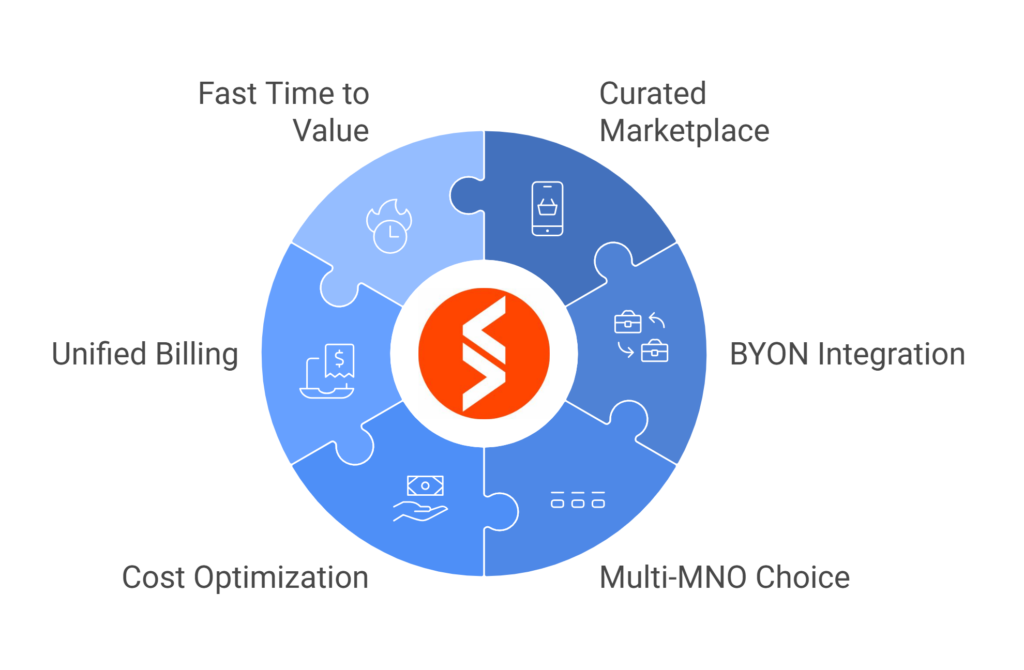
Instead of juggling dozens of different carrier portals, Spenza offers a “single pane of glass” to manage everything from legacy physical SIMs to new eSIMs through a unified dashboard. With Spenza, you can:
- Access a Curated Marketplace: Procure customizable mobile plans from leading operators worldwide, without the hassle of complex, individual negotiations.
- Bring Your Own Network (BYON): Integrate your existing carrier contracts and manage them alongside new services giving you ultimate flexibility and control.
- Multi-MNO Choice & Policy-Based Control: Select local carriers per region, set backup profiles, and automate failover for improved reliability.
- Cost Optimization & Wireless Expense Management (WEM): Consolidate connectivity contracts, invoices, usage, and operator relationships in one platform to identify cost opportunities and enforce connectivity policies.
- One Platform, One Bill: Enjoy streamlined procure-to-pay workflows and unified inventory management across devices, SIMs, and subscriptions.
- Fast Time to Value: Spenza’s no-code components and pre-integrations like Shopify help brands launch quickly.
Use Case in Action: Smart Metering Deployment
Let’s see how this works in a real-world scenario.
The Scenario: A global utility company deploys 500,000 smart meters, each with an expected 15-year operational life.
With Traditional SIMs: The meters are deployed with 4G SIM cards from a single national carrier. In year 8, that carrier announces it will sunset its 4G network within 24 months to reallocate spectrum for 6G. The utility now faces a catastrophic choice: write off millions of dollars in perfectly functional hardware or spend tens of millions on a massive truck roll campaign to physically replace every single SIM card.
With eSIM + Spenza: The utility deploys meters with eSIMs managed through the Spenza platform. If the existing carrier becomes unsuitable because of a network transition, coverage issue, commercial change, or regulatory requirement, the operations team can evaluate and manage an alternative supported operator profile remotely. This can reduce the need for physical SIM replacement, provided the meter hardware, radio capabilities, operator profile, and provisioning architecture support the target connectivity.
Roadmap to Eliminating Carrier Lock-In
Migrating to an eSIM-first strategy is a strategic initiative. Here’s a simple roadmap to get started:
- Evaluate Your Foundation: Assess your current device hardware for eUICC compatibility and review your existing connectivity contracts to identify upcoming points of inflexibility.
- Choose a Connectivity Management Partner: Select a platform that can manage your existing and future connectivity, supports the relevant eSIM/RSP architecture, provides multi-operator connectivity options, and gives your team centralized control over SIM/eSIM lifecycle operations.
- Deploy with Confidence: Develop a phased rollout strategy. Start with a proof-of-concept on a new deployment to validate the technology and processes before scaling fleet-wide.
Conclusion: Own Your Connectivity, Own Your Future
In today’s evolving technological landscape, carrier lock-in is no longer a necessity—it’s a choice. Clinging to the old model of physical, single-carrier SIMs exposes your organization to unacceptable levels of financial, operational, and technological risk.
eSIM technology provides freedom, and the new SGP.32 standard puts the controls firmly in your hands. But it is a powerful connectivity management platform like Spenza that provides the strategy, turning that raw capability into a powerful competitive advantage. The future of the Industrial IoT is flexible, resilient, and enterprise-controlled.
FAQs
Ready to de-risk your IIoT deployments and take full control of your global connectivity? Schedule a free demo with a Spenza expert today.


