


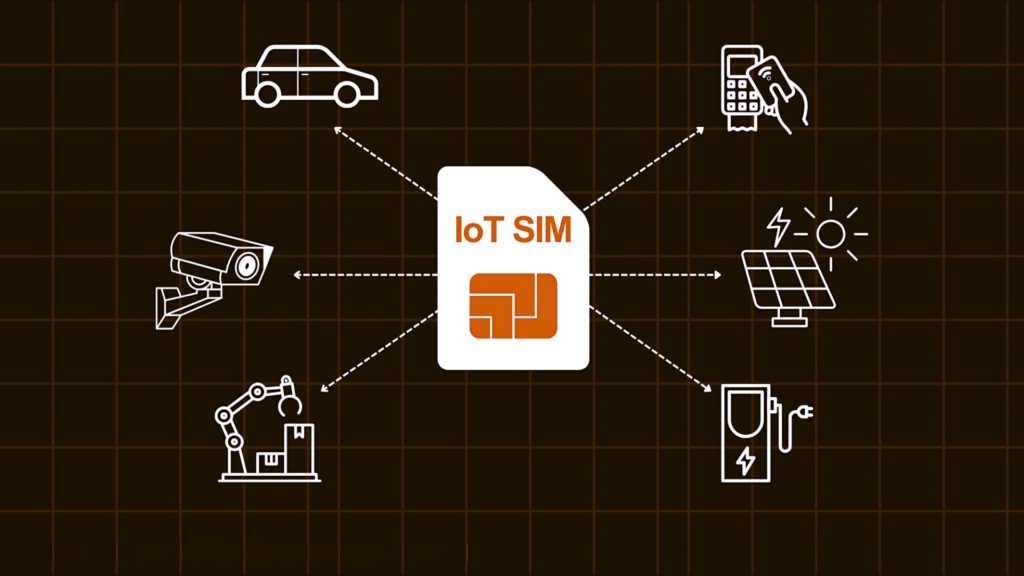
Here’s an uncomfortable truth about IoT deployments: teams will spend weeks benchmarking sensors, negotiating cloud contracts, and stress-testing firmware, then pick the SIM card in an afternoon. That decision comes back to bite them. Hard.
The SIM is the one component that decides whether your device actually connects. Get it wrong, and you’re dealing with coverage dead zones, surprise roaming bills, or a fleet that’s locked to a carrier you want to leave.
According to IoT Analytics, connected IoT devices hit 21.1 billion in 2025 and are tracking toward 39 billion by 2030. Cellular IoT connections alone grew 16% year over year in 2024. Behind every one of those connections sits a SIM card or its embedded, software defined equivalent.
An IoT SIM card is a subscriber identity module built specifically for machine to machine communication. It authenticates your device on a cellular network, handles data transmission and sometimes SMS, but typically skips voice. It’s not a phone SIM stuffed into a tracker. The hardware is different. The management is different. The economics are different.
This guide covers all of it: every type of IoT SIM available in 2026, the form factors and technologies behind them, what you’ll actually pay, and a concrete framework for evaluating providers. If you’re an IoT product manager, hardware engineer, or procurement lead trying to make a decision that your team won’t regret for the next decade, this is the page to bookmark.
Already know the basics? Jump straight to the Evaluation Framework.
What Is an IoT SIM Card? (And Why It’s Not a Phone SIM)
An IoT SIM card (or M2M SIM) is a specialized SIM card designed for cellular-enabled “Internet of Things” devices, enabling them to connect, transmit data, and be managed remotely, typically over LTE, 5G, or low-power networks. Unlike consumer SIMs, they offer global connectivity, durable form factors (eSIM), and robust management platforms for mass deployment.
At the chip level, an IoT SIM does the same job as the SIM in your phone: it stores subscriber credentials and authenticates the device to a cellular network. That’s where the similarities end.
Consumer SIMs are designed for people who upgrade phones every two to three years. IoT SIMs are designed for smart meters that sit on utility poles for fifteen years, or GPS trackers bolted to shipping containers that cross oceans in freezing rain. The engineering targets are completely different:
IoT SIM vs Consumer SIM: Quick Comparison
| Feature | IoT SIM | Consumer SIM |
|---|---|---|
| Temperature Range | -40°C to +105°C | 0°C to +45°C |
| Lifespan | 10–15+ years | 2–3 years |
| Read/Write Cycles | 500K+ | ~100K |
| Remote Management | Full OTA provisioning | Physical swap required |
| Multi-Network | Multi-IMSI / eUICC | Single carrier |
| Pricing Model | PAYG / Pooled / Lifetime | Monthly voice + data bundle |
| Primary Use | Data & SMS (M2M) | Voice, data, SMS (human) |
| Typical Data Usage | KB to low MB/month | GB/month |
Never use a consumer SIM for production IoT. Even if it works during prototyping, consumer plans lack fleet management APIs, environmental durability, and long-term pricing stability required for deployments. The cost of replacing failed SIMs across a distributed fleet often far exceeds any initial savings.
Types of IoT SIM Cards
1. Standard IoT SIMs
Standard IoT SIM cards support typical IoT communication needs. They are suitable for non-demanding IoT applications where environmental challenges are minimal. These SIMs generally support multiple networks, ensuring consistent connectivity as devices move across regions.
2. Industrial IoT SIMs
Industrial IoT SIMs are built for use in rigorous industrial environments. These SIM cards are heavily shielded against harsh elements such as temperature variations, moisture, and chemical exposure. Their design enables them to maintain cellular connectivity in scenarios where consumer-grade SIMs would fail, such as in manufacturing plants or on shipping containers.
The improved durability of industrial IoT SIMs also includes extended lifespans, reducing the frequency of replacements. This durability ensures that connected machinery and infrastructure systems can operate reliably over long periods.
3. Automotive IoT SIMs
Automotive IoT SIMs are tailored for vehicular applications, supporting high mobility and connectivity needs. They offer reliable performance in dynamic environments, maintaining reliable connections that are essential for modern vehicle telematics solutions such as GPS tracking and automotive diagnostics.
These SIMs cater to the rapid movement and handover between networks that vehicles experience. They are also designed to withstand the vibration and temperature fluctuations typical in automotive scenarios. Automotive IoT SIMs often include features that allow seamless cross-border connectivity, critical for fleet management solutions operating internationally.
IoT SIM Form Factors: A Visual Guide
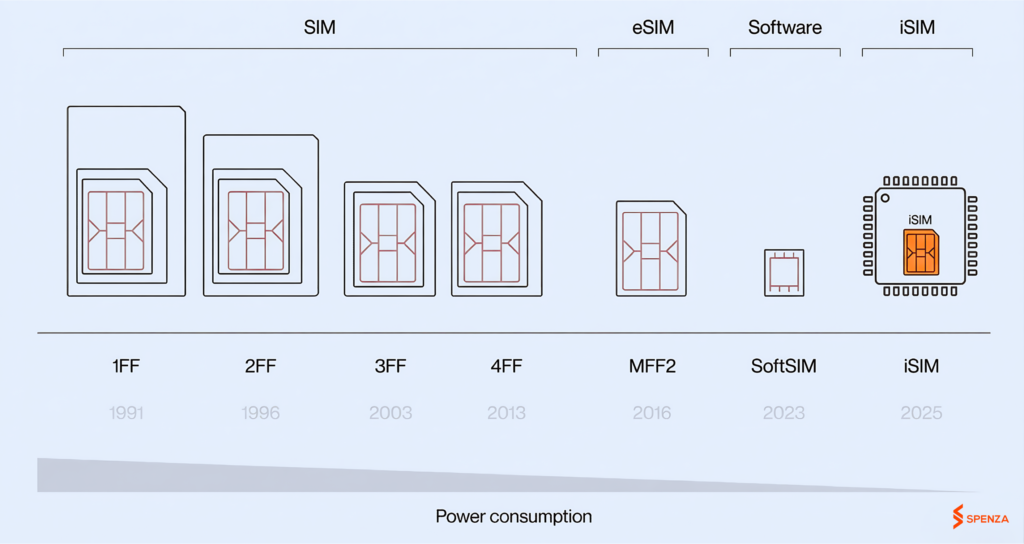
The physical shape of your SIM matters more than most teams realize. It determines what hardware you can use, how easily you can service devices in the field, and whether your SIM will survive the operating environment. Here’s every form factor you’ll encounter in 2026:
| Form Factor | Dimensions | Best For | Notes |
|---|---|---|---|
| 1FF (Full SIM) | 85.6 × 53.98 mm | Early mobile phones, legacy telecom systems | Credit-card sized; obsolete today and only found in very old or niche equipment |
| 2FF (Mini SIM) | 25 × 15 mm | Legacy industrial equipment, retrofits | Being phased out. Still found in older gateways. |
| 3FF (Micro SIM) | 15 × 12 mm | Mid-gen IoT modules, routers | Common in devices designed 2015–2020. |
| 4FF (Nano SIM) | 12.3 × 8.8 mm | Modern IoT devices, consumer IoT | Standard in most new hardware. Triple-cut cards include 2FF/3FF/4FF. |
| MFF2 (Embedded) | 6 × 5 mm | Automotive, smart meters, harsh environments | Soldered to PCB. Non-removable. Industrial-grade by default. Supports eUICC. |
| iSIM (Integrated) | Sub-1 mm² | Ultra-compact wearables, constrained devices | Built into the SoC. Smallest footprint, lowest power draw. Still early-stage. |
| SoftSIM | No physical chip | Devices with existing secure element | 100% software-based. Eliminates physical SIM entirely. Pioneered by Onomondo. |
Picking the Right Form Factor
- Deploying new hardware? Go with MFF2 (embedded) or iSIM. They’re more durable and future-proof.
- Retrofitting existing devices? Triple-cut SIMs (2FF/3FF/4FF) give you flexibility across device generations.
- Building ultra-compact wearables or sensors? iSIM or SoftSIM reduces board space and power consumption.
IoT SIM Technologies: From Traditional SIM to SGP.32
This is where most buyer’s guides fall short. They describe SIM types as static product categories. In reality, SIM technology is an evolution, and where you enter that timeline determines your flexibility for the next decade.
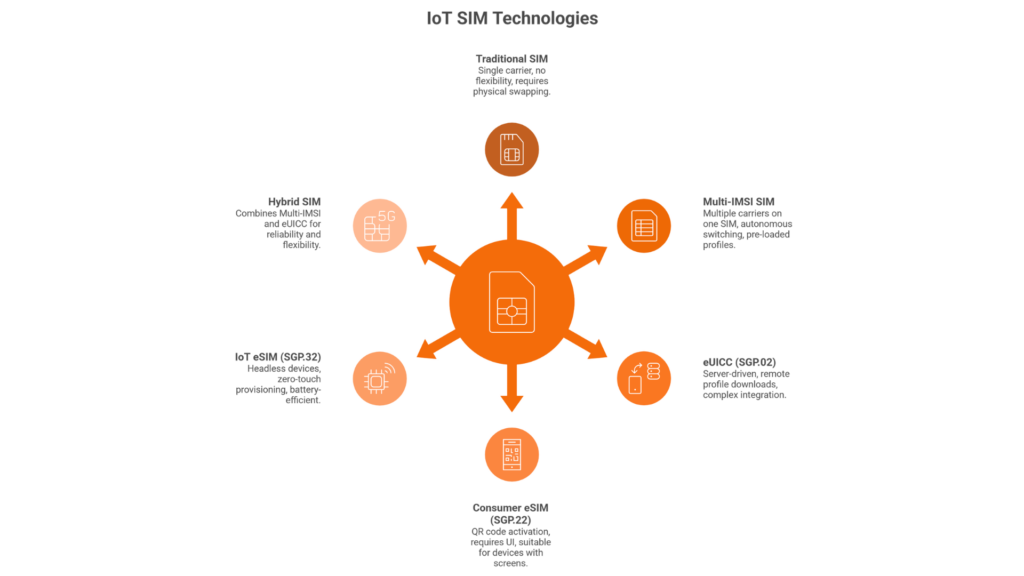
1. Traditional SIM (Single IMSI)
One SIM, one carrier, zero flexibility. Deploy in Germany with Deutsche Telekom, and you’re committed. Changing carriers means physically swapping SIMs across your entire fleet, including truck rolls and all. Still viable for single country, single carrier deployments where you don’t anticipate change. But “don’t anticipate change” is a bold assumption for a device with a 10 year lifespan.
2. Multi-IMSI SIM
One SIM stores multiple carrier identities. The device can switch between carriers autonomously based on signal strength, cost rules, or location, in under a minute, without needing an internet connection. Multi IMSI is the tried and tested approach for global IoT. The catch: profiles are pre-loaded at manufacturing. You can’t add new carriers after the SIM ships. It’s a closed system, but a reliable one.
3. eUICC / eSIM (SGP.02 M2M Standard)
The original GSMA remote SIM provisioning standard for M2M. A server-driven model where SM-DP (profile preparation) and SM-SR (secure routing) handle profile downloads over the air. The upside: you can change carriers remotely. The downside: complex integration, slow profile switching, and high protocol overhead. Adoption has been concentrated mostly in automotive, where the engineering budgets can absorb the complexity.
4. Consumer eSIM (SGP.22)
Designed for smartphones and wearables, devices with screens. You scan a QR code, the profile downloads, and you’re connected. Clean user experience, but it requires a UI and user interaction to activate. That makes SGP.22 a poor fit for headless IoT devices, which is most IoT devices. It works well for consumer IoT with displays: smartwatches, tablets, connected health monitors.
5. IoT eSIM (SGP.32): The 2026 Standard
This is the one that changes the game for IoT. SGP.32 was purpose built for headless devices, with no screen and no user interaction required. Zero touch provisioning at fleet scale. The protocol uses lightweight CoAP over UDP with DTLS, which saves battery compared to SGP.22’s HTTPS. It introduces the eSIM IoT Manager, or eIM, for server driven orchestration across massive fleets.
SGP.32 removes operator lock-in by design. It’s the right fit for deployments above 50,000 devices, multi-country rollouts, and any scenario requiring automated lifecycle management. Still in early commercial rollout as of 2026, but the ecosystem is moving fast.
Avoid providers offering only traditional single-IMSI SIMs in 2026. You risk committing to a technology that may feel obsolete within a few years. At a minimum, insist on eUICC support and ask whether SGP.32 is on their roadmap.
6. Hybrid: Multi-IMSI + eUICC
The 2026 best practice for most enterprises. Multi-IMSI provides instant, autonomous carrier switching on day one, no server connection needed. eUICC gives you the strategic flexibility to add or change carriers over the device’s 10 to 15-year lifecycle via OTA updates. You get the reliability of multi-IMSI and the future-proofing of eUICC in one card.
IoT SIM Pricing Models: What You’ll Actually Pay
Most IoT SIM guides dodge the pricing question. We won’t. Pricing is one of the top three reasons teams switch providers, usually because the first contract had costs buried in the fine print. Here’s what the market looks like in 2026:
| Pricing Model | Typical Cost | Best For | Watch Out For |
|---|---|---|---|
| Pay-As-You-Go (PAYG) | $0.02–$0.10/MB | Variable or unpredictable usage | Costs spike quickly if usage increases unexpectedly |
| Monthly Subscription | $1–$15/device/month | Predictable-usage deployments | You pay even when devices are idle or underutilizing |
| Pooled Data Plans | Varies by pool size | Mixed fleets (sensors + cameras) | Pool minimums may exceed actual usage for small fleets |
| Lifetime Flat | $15 one-time (e.g., 1NCE: 500MB + 250 SMS over 10 years) | Ultra-low-data, set-and-forget devices | Hard data cap with no economical top-up path for some providers |
The Hidden Costs Nobody Talks About
The per-MB rate is never the full story. Before signing, check for:
- Activation fees: Some providers charge $0.50–$5 per SIM just to turn it on.
- Minimum commitments: Annual volume floors that trigger penalties if unmet.
- Overage charges: Per-MB surcharges that can be 5–10x the base rate.
- Roaming surcharges: Extra fees when devices connect outside the home network.
- Inactivity fees: Charges for dormant or suspended SIMs, common and easily overlooked.
- Contract termination penalties: Early exit fees that can lock you in for years.
- SIM shipping and logistics: Physical SIM cards need warehousing and distribution.
An operator-neutral connectivity management platform (CMP) can compare pricing across multiple carriers in real time, helping you avoid overpaying and detect billing anomalies early before they compound.
How to Choose an IoT SIM In 2026
Forget feature lists. What you need is a framework that forces the right questions. Run every potential provider through these eight criteria before signing anything:
- Coverage Footprint: How many countries and networks does the provider support? Is connectivity roaming based (risky in markets with permanent roaming bans) or localized profiles (regulatory compliant)? Check restrictions in your specific target markets: Brazil, China, Turkey, India, and Saudi Arabia all ban or restrict permanent IoT roaming.
- SIM Technology: Does the provider offer eUICC? Is SGP.32 on their product roadmap? Can you get a hybrid multi-IMSI plus eUICC SIM? Providers still offering only single-IMSI cards in 2026 are a red flag.
- Network Technology Support: Do the SIMs support LTE-M, NB-IoT, 5G, and Cat-1, or just 4G LTE? For devices with 10 plus year lifecycles, surviving 2G/3G sunsets and future network transitions is non-negotiable.
- Management Platform & API: Can you activate, suspend, monitor, and configure alerts via API? Real-time usage dashboards? Bulk operations for large fleets? If the provider’s “platform” is a spreadsheet they email you monthly, walk away.
- Pricing Transparency: Are all fees listed upfront? Ask specifically about roaming surcharges, overage penalties, inactivity fees, and minimum volume commitments. If you cannot get a straight answer before signing, you will not get one after.
- Security: Private APN support? VPN tunneling? IMEI locking? Compliance certifications like GDPR and ISO 27001? For regulated industries, this is not optional.
- Lock-in Risk: Can you switch providers without replacing hardware? eUICC enables this. Ask the question directly: “If we want to leave in two years, what happens to our devices?” The answer tells you everything.
- Scalability: Can the provider support you from 100 SIMs to 100,000? What is the onboarding process for new countries? Some providers excel at small pilots but choke at production scale.
Global IoT SIM Deployment: Roaming, Localization, and Compliance
Deploying IoT across borders is where things get tricky and where bad SIM decisions cause the most damage.
1. The Permanent Roaming Problem:
Most countries allow temporary roaming but restrict or ban permanent roaming for IoT devices. Brazil, China, Turkey, India, and Saudi Arabia have outright prohibitions. Even in more permissive markets, local operators can throttle or disconnect permanently roaming devices without warning. These restrictions affect markets covering more than half the world’s population.
2. Localization Strategies:
Three approaches work: eUICC profile switching to download local carrier profiles over the air, multi-IMSI with pre-loaded local identities that the device selects automatically, and local breakout routing through regional packet gateways. Each has tradeoffs in speed, cost, and regulatory compliance. The right choice depends on your specific target markets.
3. Single-SKU Global Deployment:
The holy grail of IoT logistics is to manufacture one product, embed one SIM, ship anywhere, and activate locally over the air. A hybrid multi-IMSI plus eUICC architecture makes this achievable. You avoid maintaining separate hardware SKUs per region and simplify supply chain management considerably.
4. 2G/3G Sunset Impact:
Legacy SIMs that only support 2G or 3G are losing value fast as networks shut down worldwide. Any SIM purchased in 2026 must support LTE-M, NB-IoT, or 4G LTE at minimum. If you are still running devices on sunset networks, the migration clock is already ticking.
Industry Use Cases: Matching SIMs to Verticals
Different industries have different connectivity profiles. Here is a practical mapping of SIM recommendations by vertical based on real deployment patterns, not theory:
| Industry | Recommended SIM Tech | Form Factor | Pricing Model | Key Requirement |
|---|---|---|---|---|
| Fleet Management | LTE-M with multi-IMSI | MFF2 | Pooled data | Cross-border mobility, continuous tracking |
| Smart Metering | NB-IoT with eUICC | MFF2 | Lifetime flat | 15+ year lifespan, ultra-low data |
| EV Charging | 4G LTE Cat-1, multi-network | MFF2 or 4FF | Monthly subscription | Uptime critical for payment processing |
| Wearables & Health | Consumer eSIM (SGP.22) / iSIM | iSIM or 4FF | Monthly subscription | Compact size, user-activated profiles |
| Agriculture | NB-IoT or LTE-M | MFF2 | PAYG | Seasonal usage, outdoor durability |
| Smart City / Infra | Hybrid multi-IMSI + eUICC | MFF2 | Pooled data | Decade-long deployments, mixed device fleet |
How Spenza Solves the IoT SIM Management Problem
We built Spenza because we kept seeing the same pattern: IoT teams making smart hardware decisions, then losing months and budget wrestling with fragmented SIM management. Different carrier portals for different regions. Billing spreadsheets that nobody trusts. No way to switch providers without replacing physical SIMs across an entire fleet.
Spenza is an operator-neutral connectivity enablement platform. That means we do not lock you into a single carrier. Instead, we give you one control plane to manage SIMs across every carrier, every country, and every technology, whether you are running physical SIMs, eSIMs, or a hybrid setup.
What Spenza Actually Does:
Here is the short version of how the platform works in practice:
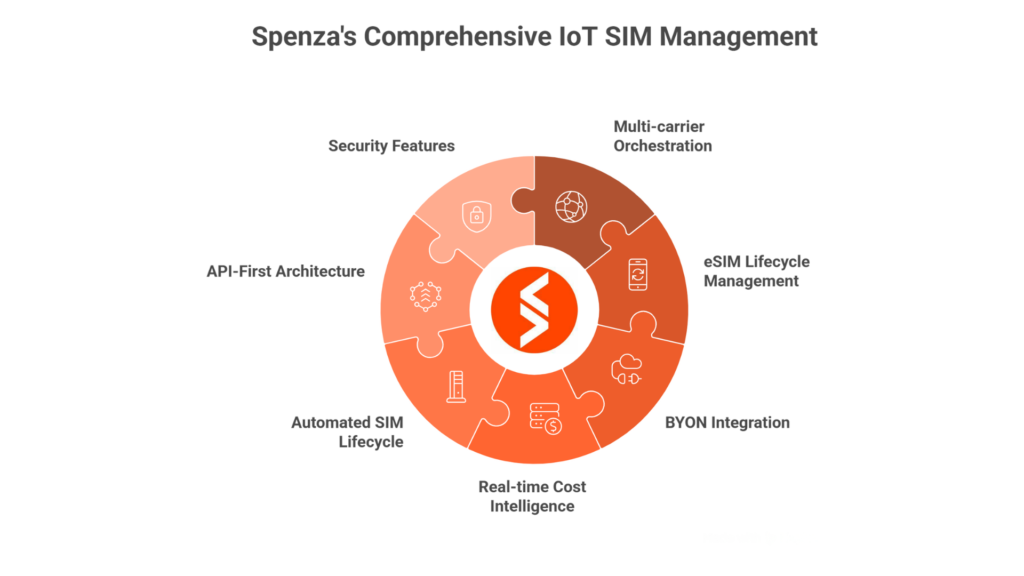
- Multi-carrier orchestration across 190+ countries: One API, one dashboard, one invoice, regardless of how many carriers your fleet touches.
- eSIM and eUICC lifecycle management: Provision, switch, and retire carrier profiles over the air. No truck rolls, no SIM swaps, no downtime.
- Bring Your Own Network (BYON): Already have carrier contracts you are happy with? Plug them in. Spenza manages them alongside our marketplace of 250+ global and regional operators.
- Real-time cost intelligence: Usage analytics, anomaly detection, and automated alerts catch billing problems before they compound. Teams using the platform typically see 20 to 40 percent savings compared to managing carriers directly.
- Automated SIM lifecycle: Devices that go silent for 30 days get auto-suspended. New devices activate on first connection. Ghost SIMs stop draining your budget.
- API-first architecture: REST APIs, webhooks, and pre-built connectors for Salesforce, Shopify, Slack, and major cloud platforms. Connectivity integrates into your existing workflows, not the other way around.
- Security built into the connectivity layer: Private APNs, IMEI locking, SIM-level firewalls, and granular network controls. Not bolted on after the fact.
Why Spenza:
Every evaluation criterion outlined in the framework above, including coverage footprint, SIM technology, pricing transparency, lock-in risk, API quality, and scalability, is something the platform was designed around. Spenza does not manufacture SIMs or own cell towers. We orchestrate the carriers that do and give you the visibility and control to make better decisions across all of them.
If you are managing fewer than 100 devices in a single country, you might not need a platform yet. But the moment your fleet crosses borders, touches multiple carriers, or scales past the point where spreadsheets hold up, that is when the complexity hits. And that is the problem we solve.
| Capability | What It Means for You |
|---|---|
| Operator-neutral | No vendor lock-in. Switch carriers without switching platforms. |
| 190+ country coverage | One SIM SKU, global activation. Ship anywhere, connect locally. |
| eUICC / SGP.32 ready | Remote profile provisioning and carrier switching over the air. |
| BYON support | Keep existing carrier contracts. Layer Spenza on top. |
| Real-time analytics | Catch overages, ghost SIMs, and anomalies before the invoice arrives. |
| API-first | REST APIs and webhooks. Integrates with ERP, CRM, and cloud IoT stacks. |
| Automated lifecycle | Auto-suspend idle SIMs, auto-activate on first connect. |
| Unified billing | One invoice across all carriers, countries, and SIM types. |
The Bottom Line
Three things to take away from this guide:
- IoT SIMs are not consumer SIMs: They are purpose built for machine communication, with different hardware, different management, and different economics. Treating them as interchangeable is a mistake you will pay for in year two.
- The SIM technology you choose today determines your flexibility for the next decade: eUICC with SGP.32 readiness is the 2026 baseline. Anything less, and you are building lock-in into your own deployment.
- Evaluate providers on coverage, technology roadmap, pricing transparency, and lock-in risk: Not just per-MB cost. The cheapest SIM is rarely the cheapest deployment.
FAQs
Ready to simplify your IoT SIM management? Book a demo with Spenza and see how our platform helps you manage global IoT connectivity.


