


Why Do MVNOs Fail? The Short Answer
MVNOs fail when the unit economics never worked and nobody stress-tested them. The technology has been solved for a decade. What has not changed is that a subscriber costs money to acquire, costs money every month, and leaves faster than you expect.
The US market makes that harder than most. More than 120 MVNO brands compete here, the three national carriers run their own value sub-brands, and Americans used 132 trillion megabytes of wireless data in 2024, the third straight year of roughly 35 percent growth. Usage climbs, retail prices do not, and the gap lands on your gross margin.
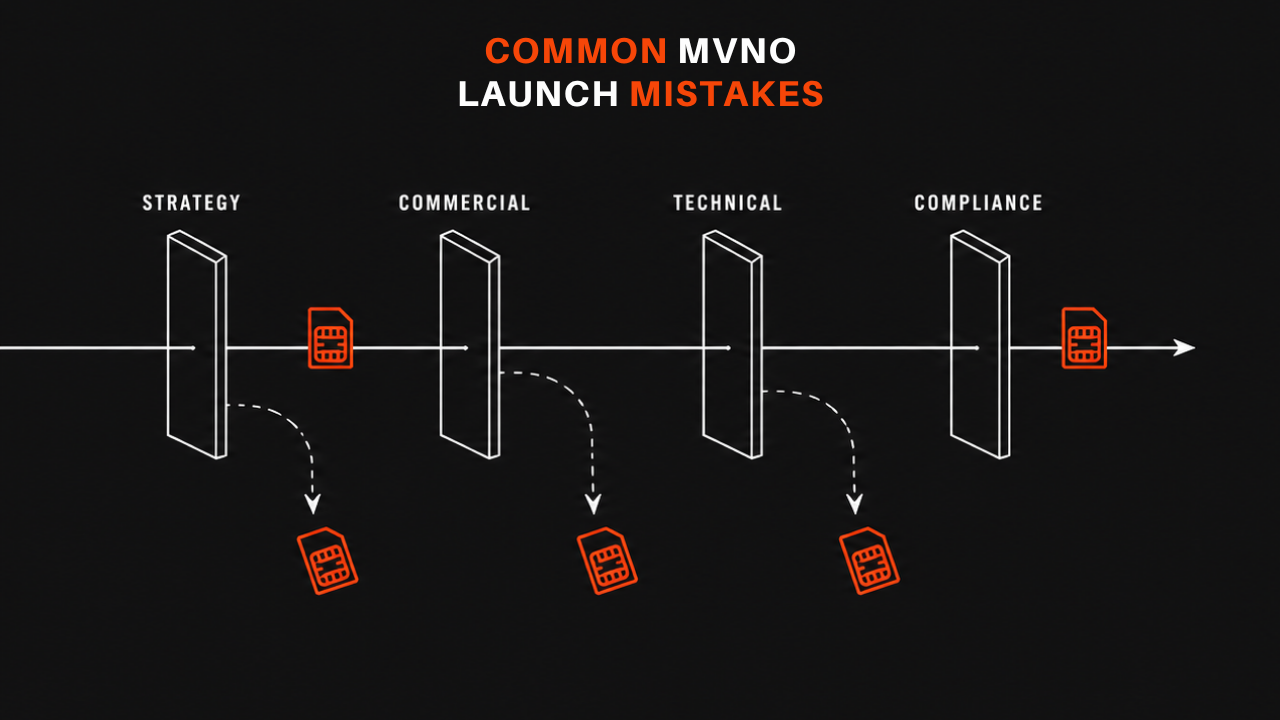
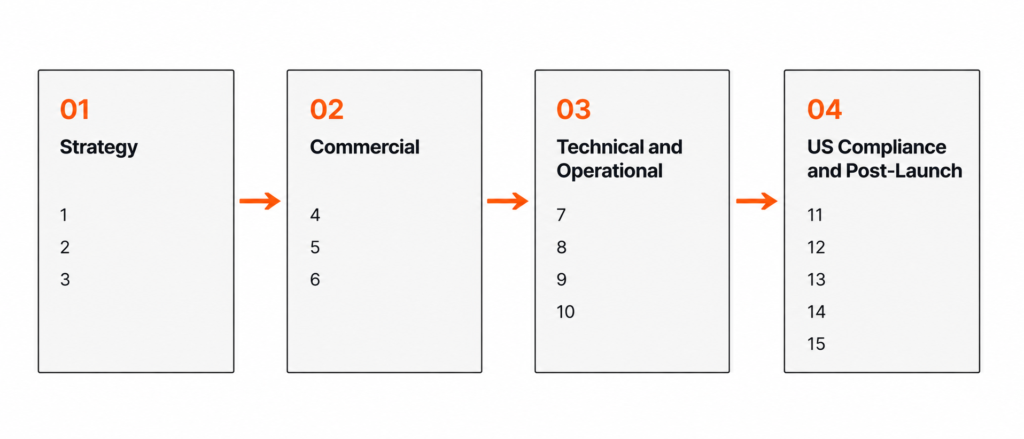
So the common MVNO mistakes are ordinary decisions made early, with optimistic numbers, that compound. Below are fifteen of them, grouped by the stage where they happen, each with a warning sign you can check against your own plan today.
The 15 Most Common MVNO Launch Mistakes at a Glance
Read the warning sign column first. If two or more describe your current plan, do the fix before you sign anything.
| # | Mistake | Early Warning Sign | The Fix | Category |
|---|---|---|---|---|
| Strategy | ||||
| 1 | No real differentiation | You cannot name your customer in one sentence. | Pick one segment and build pricing, support, and distribution around it. | Strategy |
| 2 | A plan built on generous assumptions | Churn looks low, ARPU looks high, support looks cheap. | Rebuild the model at half your forecast volume and double your churn. | Strategy |
| 3 | Underestimating capital and runway | Burn rises faster than net adds every month. | Fund 18 months, not 6. Model wholesale deposits and support separately. | Strategy |
| Commercial | ||||
| 4 | Signing a wholesale agreement you cannot live with | High minimum commitments, no renegotiation clause, no VoLTE or 5G language. | Negotiate volume flexibility, QoS, and a rate review tied to usage bands. | Commercial |
| 5 | Pricing from competitor screenshots | Margin per GB falls as usage grows. | Price up from wholesale cost, taxes, and support, then compare to market. | Commercial |
| 6 | Chasing subscribers instead of quality revenue | Gross adds rise while contribution margin stays flat. | Track margin and payback per acquisition cohort, not headline growth. | Commercial |
| Technical and Operational | ||||
| 7 | Treating an MVNO as simple reselling | No owner for activation failures, rating disputes, or porting. | Assign day-two operations ownership before day one. | Technical & Operational |
| 8 | Launching with billing and BSS half integrated | Double charges, failed payments, manual credits. | Run rating, billing, and dunning against real traffic in staging first. | Technical & Operational |
| 9 | Skipping eSIM-first onboarding | Large drop-off between purchase and first data session. | Instant eSIM activation. Check device eligibility before checkout. | Technical & Operational |
| 10 | Ignoring fraud and revenue leakage | Unexplained usage spikes, chargebacks, SIM farming. | KYC at signup, real-time usage caps, monthly rated-versus-billed reconciliation. | Technical & Operational |
| US Compliance | ||||
| 11 | Missing US regulatory registrations | No FRN, no Form 499 plan, no CPNI or E911 owner. | Register early or use an MVNE as Carrier of Record. | US Compliance |
| 12 | Pricing without telecom taxes and USF | Retail price set with no tax and fee layer. | Model taxes, USF, and state fees into pricing from the first spreadsheet. | US Compliance |
| 13 | Ignoring messaging and voice compliance | OTP texts undelivered. Outbound calls labelled as spam. | Register A2P 10DLC brand and campaigns. File in the Robocall Mitigation Database. | US Compliance |
| Post-launch | ||||
| 14 | Depending on a single host MNO | No fallback if terms change or a network sunsets. | Prefer multi-carrier access. Plan the renegotiation before you need it. | Post-launch |
| 15 | Misreading a growth stall as a marketing problem | Growth slows and the reflex is to discount and spend. | Diagnose first: segment ceiling, churn, or unit economics. | Post-launch |
MVNO Strategy Mistakes
These three happen before anyone writes code, and they are the ones no platform partner can fix for you.
1. Launching Without Real Differentiation
The generic cheap-SIM play loses. You cannot out-price a carrier that owns the spectrum, and any discount you offer is one they can match on Tuesday. The brands that keep subscribers own a specific group: diaspora communities calling one corridor, RV owners who care about coverage maps more than gigabytes, contractors who want lines they can switch on by the week.
Warning sign: you cannot describe your customer in one sentence without using the word “everyone” or the word “affordable”.
The fix: choose one segment and let it decide your pricing, support hours, channel, and app. Reach matters less than fit, and the celebrity MVNO record is a useful reminder that a large audience and the right audience are different things.
2. Building the Plan on Generous Assumptions
Almost every failed model shares three inputs: churn set too low, ARPU set too high, support cost set near zero. Each is defensible alone. Together they turn a business that loses money into a spreadsheet that makes money.
Warning sign: your model assumes 1.5 percent monthly churn because that is what the national carriers report. Their postpaid churn sits under 1 percent because of device contracts, family plans, and bundled home internet. You have none of those.
The fix: rebuild the model at half your forecast volume and double your assumed churn. If it still clears, you have a business. Run the same numbers through the MVNO launch cost calculator before you commit to a wholesale term.
3. Underestimating Capital and Runway
Founders budget for the platform and forget what surrounds it: the wholesale deposit, SIM inventory, the payment gateway reserve, three months of support before self-service works, and marketing that keeps running while payback catches up.
Warning sign: your burn is rising faster than your net adds two months running, and the plan has no line item for whatever caused it.
The fix: fund eighteen months. Six months assumes you find product-market fit on the first attempt. The build-versus-partner decision is largely a runway decision, which is why most new operators start as light MVNOs and take on core infrastructure later, if ever.
MVNO Commercial Mistakes
This group decides whether each subscriber earns money. Get these wrong and growth makes the problem bigger, not smaller.
4. Signing a Wholesale Agreement You Cannot Live With
The wholesale contract sets your cost floor, your feature access, and your room to move when reality differs from the forecast. Founders under time pressure sign the first workable offer and meet the constraints at renewal.
Read these clauses closely before signing:
- Minimum monthly commitments, and the penalty in months you miss them
- Whether a renegotiation clause exists, what triggers it, and how often you can use it
- Per-GB rate bands, and whether your effective rate improves or worsens as usage grows
- Explicit VoLTE, 5G, and network-sunset language, not a general reference to available services
- Data, voice, and SMS priced separately, so a usage mix shift does not surprise you
Warning sign: you cannot answer “what does this contract cost me if usage per subscriber doubles” without emailing your account manager.
The fix: model the deal across three usage scenarios before signing, and negotiate flexibility ahead of headline rate. A slightly worse per-GB price with a real renegotiation clause beats a great rate locked in for 36 months.
5. Pricing From Competitor Screenshots Instead of Wholesale Cost
Copying a competitor price copies a cost base you do not have. Then usage does what US usage keeps doing. Americans used 132 trillion MB of wireless data in 2024, roughly 35 percent more than the year before, and that pattern has held three years running. If your per-GB rate is flat and your plan price is flat, your margin is not flat. It is falling.
Warning sign: your margin per subscriber is thinner this quarter than last, and nothing about your pricing changed.
The fix: build price from the bottom: wholesale cost at expected usage, plus taxes and fees, support, payment processing, and target margin. Then compare to market. If the market price sits below your floor, the segment is wrong, not the spreadsheet. MVNO revenue models helps here, since add-ons often carry margin that raw data cannot.
Two operators may launch the same $25 monthly plan, yet end up with very different financial outcomes. One forecasts an average subscriber using 8 GB of data each month. The other models the same starting point but also accounts for 35% annual data usage growth. Eighteen months later, the first operator may be paying wholesale costs on nearly 13 GB per subscriber while still charging the original $25 price. The difference between a profitable MVNO and an unprofitable one is often determined long before launch, through realistic forecasting and financial modeling rather than pricing alone.
6. Chasing Subscribers Instead of Quality Revenue
Subscriber count is the metric investors ask about and the one that hides the most. You can grow the base every month while every incremental cohort loses money, and the total looks healthy right up until acquisition spend pauses.
Warning sign: gross adds are up and contribution margin is flat or negative.
The fix: report by cohort. For each acquisition month, track CAC, monthly contribution margin, and payback period. A cohort that pays back in nine months at $6 monthly margin is a business. A cohort that pays back in thirty-one is a subsidy.
Technical and Operational Mistakes
The platform is rarely what breaks. What breaks is everything that has to happen after a subscriber goes live.
7. Treating an MVNO as Simple Reselling
Reselling ends the moment a customer has a problem. Activations fail, ports stall at the losing carrier, a rating rule misfires and forty accounts get billed twice. If nobody owns these on day two, your support queue becomes your product.
Warning sign: you have no named owner for failed activations, porting exceptions, or rating disputes.
The fix: assign day-two ownership before day one, either to a person on your team or as a contractual responsibility on your platform partner. The MVNO launch checklist covers the full operational surface and pairs with this page: one lists what you need, this one lists what goes wrong.
8. Launching With Billing and BSS Half Integrated
Billing failures cost you customers who were otherwise happy: a double charge, a failed renewal that silently suspends service, a plan change that does not take effect until next cycle. Each is a ticket, a refund, and often a cancellation. The manual corrections then create reconciliation gaps that resurface as revenue leakage.
Warning sign: anyone on your team is issuing account credits by hand more than once a week.
The fix: test rating, billing, dunning, and plan changes against real traffic in staging before launch. Compare MVNO billing platforms on how they handle mid-cycle plan changes, proration, and failed payment retries, because that is where the tickets come from.
9. Skipping eSIM-First Onboarding
Every step between payment and first data session costs you customers. Physical SIM shipping adds three days and a delivery failure rate. Manual APN instructions add a support call. A QR code buried in an email adds measurable drop-off.
Warning sign: a meaningful gap between paid signups and first data session, and nobody is tracking it as a funnel step.
The fix: instant eSIM provisioning with in-app activation, and device eligibility checked before checkout rather than after. An eSIM compatibility check at the top of the funnel prevents refunds at the bottom. If you sell through ecommerce, the Shopify MVNO launch path removes most of the manual steps.
10. Ignoring Fraud and Revenue Leakage
Fraud finds new operators quickly because new operators have the loosest controls. The CFCA estimated global telecom fraud losses at $38.95 billion in 2023, up 12 percent year over year. For a small MVNO the damage is rarely one large event. It is subscription fraud on stolen cards, SIM farming against your international rates, and a slow gap between rated and billed usage.
Warning sign: usage spikes you cannot explain, a rising chargeback rate, or a rated-versus-billed difference nobody reconciles.
The fix: KYC at signup, velocity limits on new accounts, real-time caps on international and premium destinations, and a monthly reconciliation of rated usage, invoiced revenue, and collected cash. Three numbers, once a month. Most leakage shows up there first.
US Compliance Mistakes (FCC, CPNI, E911, and 10DLC)
This is where US launches get delayed, and where almost every competing article stops short. None of it is optional, and none of it has a small-provider exemption you can rely on.
11. Missing US Regulatory Registrations
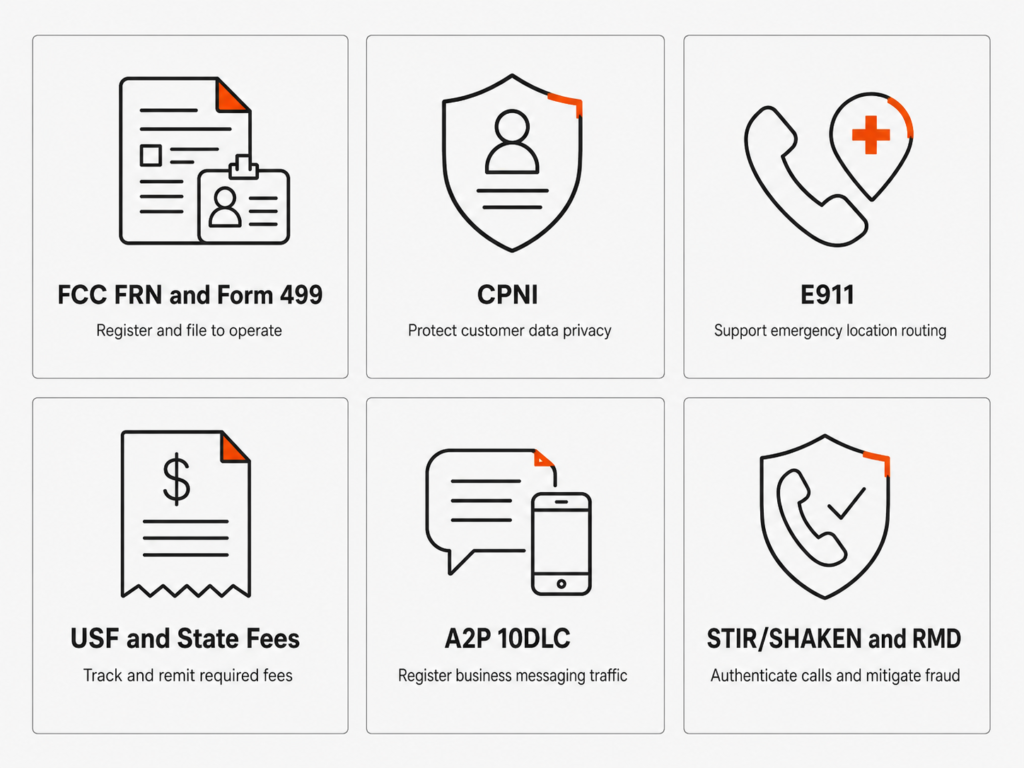
You need an FCC Registration Number through CORES before you can do most business with the Commission. Most providers of interstate telecommunications also carry FCC Form 499 filing obligations and contribute through USAC. The CPNI rules at 47 CFR 64.2001 require you to protect customer call detail and account data, train staff on handling it, and file an annual compliance certification with the FCC Enforcement Bureau by March 1 each year. E911 obligations cover routing emergency calls and delivering caller location to the answering point.
Warning sign: no FRN, no owner for the annual CPNI certification, and no answer for how a 911 call on your service reaches the right dispatcher.
The fix: give each obligation a named owner and a date, or use an MVNE acting as Carrier of Record to absorb the filings. That is one of the more legitimate reasons founders take the partner path. The MVNO regulatory guide covers the obligations in more depth.
12. Pricing Without Telecom Taxes and USF
Taxes, fees, and government surcharges averaged 27.6 percent of a typical US wireless bill in 2025, a record high, ranging from 16.82 percent in Idaho to 38.32 percent in Illinois. On the federal side, the FCC universal service contribution factor reached 38.8 percent for Q3 2026, the highest in the fund history, applied to assessable interstate and international end-user revenue. Whether you absorb these or pass them through changes your effective price and your margin.
Warning sign: your pricing model has one line called “revenue” and no line called “taxes and regulatory fees“.
The fix: decide the pass-through policy before you publish a price, model it by state rather than nationally, and confirm your billing system presents it correctly on the invoice. A national launch is not a single tax position.
13. Ignoring Messaging and Voice Compliance
Since early 2025, AT&T, T-Mobile, and Verizon block unregistered application-to-person traffic on 10-digit numbers outright rather than filtering it. If your brand and campaigns are not registered with The Campaign Registry, your one-time passcodes do not arrive, and you will see it as a login failure rate rather than a messaging problem. On voice, STIR/SHAKEN caller ID authentication sets your attestation level, and weakly attested calls get labelled as spam risk and stop being answered.
Warning sign: OTP delivery under 95 percent, or a support queue full of customers who never got the code.
The fix: register the brand and every campaign use case before launch, keep sending behaviour matched to the approved use case, maintain your Robocall Mitigation Database entry, and treat OTP delivery as a first-class metric.
Post-Launch Mistakes: What Goes Wrong After Go Live
The launch worked and subscribers are activating. These two mistakes turn a working MVNO into a stalled one.
14. Depending on a Single Host MNO
One host network is one negotiation away from a different business. Terms change at renewal, coverage degrades in a region you sell into, or a network sunsets and part of your base loses service on a schedule you do not control.
Warning sign: you have no answer for what happens if your host raises rates 15 percent at renewal.
The fix: prefer multi-carrier access from the start, even if you launch on one network. Adding a second carrier later costs far more than choosing a platform that already supports it.
15. Misreading a Growth Stall as a Marketing Problem
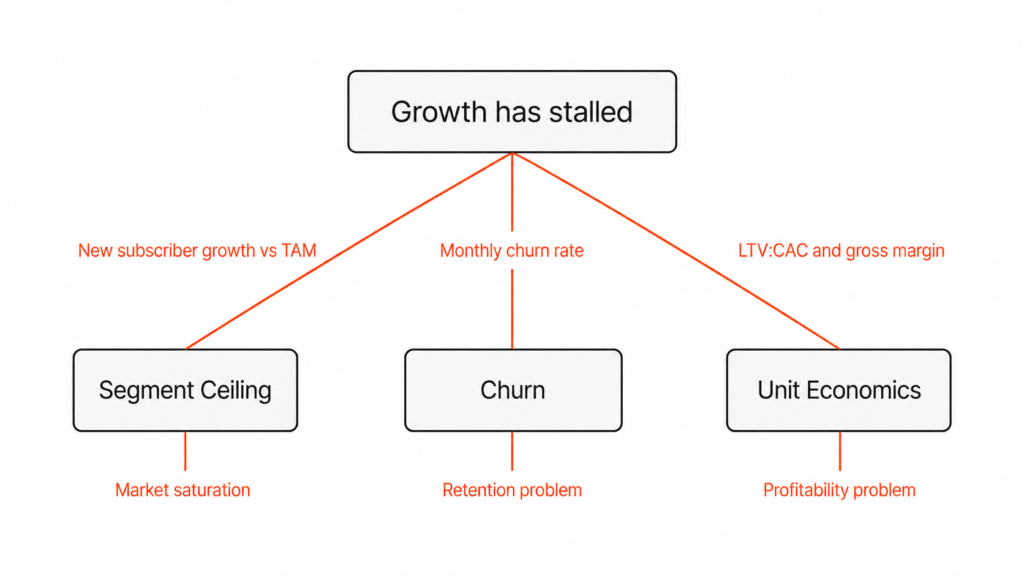
Growth slows and the reflex is to discount and raise ad spend. Sometimes that is right. More often the stall has one of three causes, and two of them get worse with more spend.
- Gross adds falling while CAC rises: you are hitting the ceiling of your segment. More budget buys worse customers. Expand the offer or the segment.
- Gross adds steady but net adds falling: churn rose and acquisition is filling a leak. Fix retention first.
- Both steady but contribution margin flat: pricing or the wholesale deal is the constraint, not demand.
The fix: separate gross adds, churn, and margin per cohort before you change the budget. A stall is a measurement question first. It is also where founders confuse execution errors with the myths they absorbed before launching.
The Hidden Costs Founders Miss
These rarely appear in a first-pass budget and reliably appear in month four.
- Support before self-service works. Ticket volume peaks in the first ninety days, when your app is least complete.
- Payment gateway reserves and chargeback fees. New telecom merchants often face rolling reserves, which is working capital you cannot spend.
- Billing system changes. Every new plan structure, promotion, or tax jurisdiction is configuration work and sometimes development work.
- SIM and device logistics. Returns, failed deliveries, and swaps carry a per-unit cost that eSIM removes almost entirely.
- Regulatory filings and professional fees. Form 499 preparation, CPNI certification, and state registrations take staff time or outside counsel.
- Marketing spend that misses. Budget for the channels that will not work. In a new segment, that is most of them at first.
Consumer vs IoT and Enterprise: Two Different Businesses
Several operators launch consumer-first, find the margin thin, then discover the same platform serves enterprise and IoT connectivity with better economics. Decide this deliberately rather than drifting into it.
| Dimension | Consumer MVNO | IoT and Enterprise MVNO |
|---|---|---|
| Usage Pattern | Volatile, grows with video and 5G | Predictable, often small per device |
| Churn | Higher, switching is instant | Lower, tied to hardware and contracts |
| Contract Term | Month to month | Multi-year, often with volume commitments |
| Support Load | High per subscriber | Lower per line, higher per account |
| Margin Profile | Thin, sensitive to usage growth | More stable, priced per device or account |
| Sales Motion | Paid acquisition and retail | Direct sales, longer cycle, larger deals |
If your product is a connected device rather than a phone plan, the economics differ again. That applies to connected device OEMs and to enterprise IoT and fleet operators, where connectivity is bundled into a hardware or SaaS price rather than sold on its own.
How to De-Risk Your Launch (and Where Spenza Fits)
The fifteen mistakes split into two groups. One is structural: wholesale access, billing, provisioning, compliance filings. A platform partner removes most of that risk. The other is strategic: who you serve, what you charge, whether they stay. Nobody removes that for you. Spenza is an agentic MVNE, described in full on the MVNE platform page. Against the mistakes here:
- Mistakes 4 and 14, wholesale terms and single-carrier dependence: multi-carrier wholesale access under one commercial relationship, so a host renegotiation is not an existential event.
- Mistake 8, billing and BSS: rating, billing, plan management, and dunning already integrated and tested, not assembled during launch week.
- Mistake 9, onboarding: eSIM provisioning and instant activation, including ecommerce and in-app flows.
- Mistake 10, leakage: usage controls and spend analytics that surface anomalies before the invoice does.
- Mistakes 11 to 13, US compliance: compliance support and a Carrier of Record path, so the filings have an owner from day one.
An MVNE can reduce much of the technical, operational, and regulatory complexity involved in launching an MVNO, but it cannot determine your target market, create a compelling value proposition, set the right pricing strategy, or retain your subscribers. Those are business decisions that remain your responsibility. Any vendor that suggests a platform alone guarantees commercial success is solving only the part of the challenge it controls, not the entire business problem.
Conclusion: Building an MVNO That Lasts
Launching an MVNO is no longer a technology challenge. Success depends on building a sustainable business with realistic financial planning, clear market positioning, strong operational processes, and regulatory compliance from day one. Most MVNO failures stem from poor unit economics, weak differentiation, unfavorable wholesale agreements, and underestimating the operational and compliance requirements needed to scale.
By validating assumptions early, negotiating flexible carrier partnerships, implementing reliable billing and eSIM onboarding, and tracking profitability instead of subscriber growth alone, operators can significantly reduce launch risk. An experienced MVNE like Spenza can simplify the technical, operational, and compliance aspects of launching an MVNO, but long-term success still depends on making the right strategic decisions around your target market, pricing, and customer retention. The operators that thrive in 2026 will be those that combine the right platform with disciplined execution and a clear, differentiated value proposition.
FAQs
Ready to avoid MVNO mistakes and launch your branded MVNO in just 7 days? Contact Spenza to build it with the speed, clarity, and control your team needs


