


What Is an eSIM + 5G Strategy for MVNOs?
An eSIM + 5G strategy combines digital SIM provisioning with next-generation mobile networks to simplify customer onboarding, reduce operational costs, improve service flexibility, and enable new revenue opportunities such as enterprise mobility, IoT connectivity, and premium 5G offerings. Together, these technologies help MVNOs compete on customer experience rather than price alone.
Why eSIM and 5G Are Game-Changers for MVNOs
Now, MVNOs face a choice. Stay stuck in price battles or use these technologies to grow margins, improve customer experience, and expand into IoT and enterprise. In this blog, I will explain how eSIM and 5G for MVNOs change the model and show why early adopters gain advantage in 2026.
The combination of eSIM and 5G is redefining how MVNOs launch, acquire customers, and compete. Instead of relying on physical SIM distribution and price-driven competition, modern MVNOs can deliver instant activation, personalized plans, enterprise connectivity, and global roaming through a fully digital operating model.
As eSIM adoption accelerates and 5G becomes the default mobile network, MVNOs have an opportunity to reduce operating costs while creating new revenue streams through enterprise mobility, IoT connectivity, fixed wireless access, and premium 5G services. Success increasingly depends on offering differentiated digital experiences rather than competing on price alone.
By 2026, the numbers are clear:
- Over 1 billion smartphones ship with eSIM enabled, and 3.4 billion total eSIM connections run globally (GSMA).
- 88% of carriers worldwide plan to offer eSIM by 2026.
- 2.4 billion 5G subscriptions exist today, covering one-third of all mobile users.
5G grows four times faster than 4G did. eSIM adoption climbs even faster as Apple, Samsung, and others push SIM-free devices.
This guide explains how eSIM and 5G work together to reshape MVNO economics, improve customer experience, unlock new business models, and prepare operators for long-term growth.
What Would You Get by the End of the Article?
- Real numbers on how eSIM and 5G adoption in 2026 reshape MVNO strategies.
- Clear view of cost savings from replacing physical SIMs with eSIM.
- Practical use cases for 5G network slicing as a revenue engine.
- Proof that instant MVNO activation improves sign-ups and customer experience.
- New growth opportunities in enterprise, IoT, and industry-specific MVNO services.
- How Spenza acts as the enterprise-grade eSIM MVNO platform for growth.
The Rise of Digital-First MVNOs in 2026
For years, MVNOs carried the cost of producing, shipping, and selling SIM cards. That model ends in 2026. eSIM lets customers scan a QR code or open an app, and their number activates instantly. No wait. No shipping.
Executives across telecom call this the “invisible network.” It means fewer logistics and faster onboarding. By going digital-first, MVNOs cut the cost of subscriber acquisition and remove the need for retail distribution.
Real examples prove this shift:
- Travel-focused MVNO apps grew rapidly in 2023–2024, showing demand for instant digital sign-up.
- In the U.S., 40% of devices are already eSIM-enabled thanks to iPhone and high-end Android adoption.
- By 2026, over 71% of new smartphones globally support eSIM activation.
This shift creates digital-first MVNOs that can start and scale faster. For CIOs and operations leaders, this means an MVNO in 2026 is less about SIM supply chains and more about API-driven connectivity.
(See how eSIM-only MVNOs are launching in 2026 here: Spenza guide)
5G as the Growth Engine for MVNOs
eSIM creates a smooth front-end. 5G fuels the back-end. Customers want speed, reliability, and real-time connectivity. 5G provides exactly that.
Some facts to keep in mind:
- Around 2.9–3.0 billion 5G subscriptions worldwide by the end of 2026.
- 71% 5G penetration in North America, over 50% in East Asia.
- 5G remains the fastest-adopted mobile generation, with adoption continuing to outpace 4G during comparable rollout periods.
5G MVNO services now include:
- Gigabit-speed mobile internet.
- Fixed Wireless Access MVNO offerings that compete with home broadband.
- Enterprise-ready connections for real-time apps like AR, VR, and AI-driven analytics.
And the most exciting? Network slicing. It lets MVNOs design premium plans. For example, a slice for gamers with guaranteed low latency, or a slice for healthcare with priority traffic.he global network slicing market is projected to grow from roughly US$1–2 billion today to more than US$30 billion by the early 2030s, driven by enterprise 5G adoption.
For the future of MVNO growth, 5G is not optional. Customers now expect it by default.
Reducing Costs and Unlocking New Revenue with eSIM + 5G
Every SIM card costs money to produce, ship, and manage. Multiply that by thousands of users and the expense is heavy. eSIM cuts those costs to near zero.
Let’s look at where the savings come from:
- No physical SIM manufacturing or packaging.
- No inventory management.
- No shipping or retail logistics.
- No dealer commissions for SIM sales.
Even more, eSIM cuts subscriber acquisition costs (SAC). Customers activate online without visiting a store. That lowers the marketing and retail overhead per new user.
For MVNO finance leaders, this means cost per subscriber drops while margins rise. Add to that reduced support tickets for lost or broken SIMs, and the financial case becomes obvious.
(For details on MVNO eSIM implementation, check this resource)
5G Network Slicing for New MVNO Revenue Streams
Cost savings matter, but revenue expansion is where MVNOs win. 5G network slicing creates new service tiers.
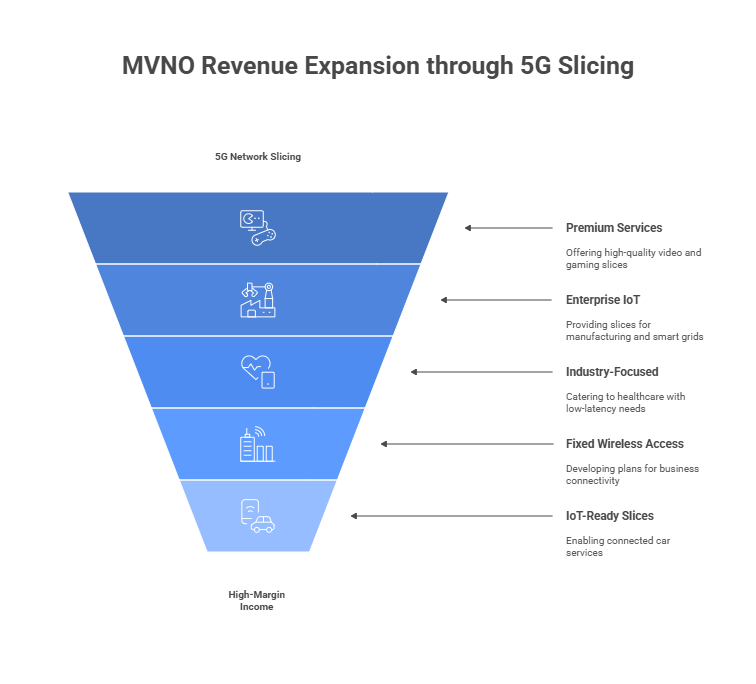
Here is how:
- Premium slices for video, gaming, or streaming.
- Specialized slices for enterprise IoT, like manufacturing robots or smart grids.
- Industry-focused slices, such as healthcare with ultra-reliable low-latency needs.
The global network slicing market is projected to grow from roughly US$1–2 billion today to more than US$30 billion by the early 2030s, driven by enterprise 5G adoption.
For an MVNO, this means creating fixed wireless access MVNO plans for businesses, or IoT-ready slices for connected cars. These services build high-margin income that goes far beyond selling cheap data.
Now that cost and revenue models are in place, let’s see how eSIM and 5G also change customer experience.
Improving Customer Experience Through eSIM and 5G
Instant Customer Onboarding with eSIM
In the past, new users waited days for SIM cards to arrive. In 2026, instant MVNO activation through eSIM changes the rule. Customers sign up online, scan a code, and connect in under 60 seconds.
This matters for:
- Young digital-first users who expect “on-demand” services.
- Travelers who need immediate local data when they land.
- Enterprises that want to activate 100 employees without shipping SIMs.
This fast onboarding boosts conversions and lowers churn. If your MVNO doesn’t offer instant activation, customers simply switch to one that does.
Personalized and Flexible 5G Data Plans
eSIM and 5G also enable personalized offers. With eSIM, users can hold multiple profiles, toggle between networks, or activate temporary plans. With 5G, MVNOs analyze real usage data and create flexible options.
Some examples:
- Weekend-only unlimited data packs.
- Streaming-focused plans with priority on video apps.
- Multi-country eSIM bundles for business travelers.
MVNO trends 2026 show that personalization drives retention. Customers want control. With eSIM and 5G, an MVNO can deliver it in real time.
Global Roaming Made Simple with eSIM
Roaming used to mean high bills and poor coverage. With eSIM, global roaming becomes smooth.
Travelers today:
- Buy local eSIM profiles before boarding a flight.
- Activate multi-country bundles on arrival.
- Enjoy 5G speeds abroad without hassle.
In fact, travel eSIM apps rank among the fastest-growing MVNO services in 2024–2025. Banks like Revolut even bundled roaming eSIM into financial services.
This shows that global eSIM roaming is not just an add-on. It is now a competitive differentiator.
eSIM + 5G Unlock Enterprise and IoT Opportunities for MVNOs
Enterprise Connectivity Solutions
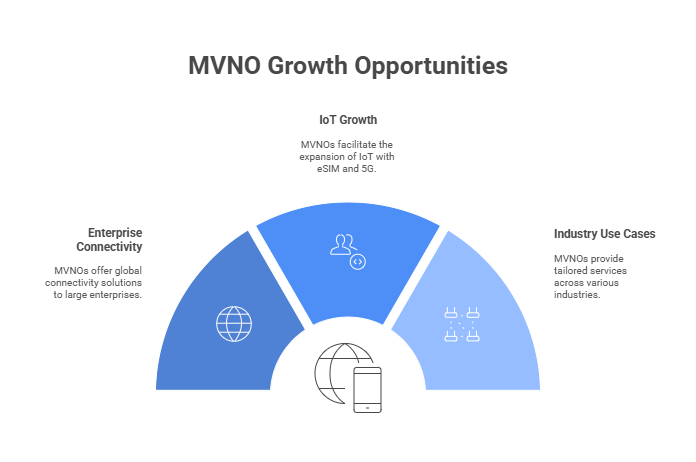
Large enterprises want global connectivity with one provider. In 2026, eSIM and 5G for MVNOs finally make this real. Companies can give employees eSIM profiles managed centrally. IT teams activate devices remotely across countries.
Businesses also demand secure, reliable 5G connections for apps, video calls, and mobile offices. MVNOs can now pitch corporate 5G plans, private slices, and fixed wireless access MVNO solutions as enterprise-grade services.
(For the enterprise regulatory angle, see this 2025 MVNO regulatory guide)
IoT Growth Powered by MVNOs
IoT will explode by the end of 2026 with 30 billion devices worldwide. Cars, wearables, sensors, and machines all need connectivity. MVNOs are stepping in as global IoT providers.
Why? Because eSIM means one device SKU works worldwide. IoT MVNOs manage profiles remotely. 5G then supports massive device density and low latency.
The IoT eSIM market grows from $11.7 billion in 2023 to $30+ billion by 2030. For MVNOs, IoT growth equals steady, large-scale contracts.
(See IoT MVNO use cases here: IoT MVNO with eSIM)
Industry-Specific Use Cases
MVNO trends 2026 highlight vertical-focused MVNOs:
- Banks launch branded eSIM services for travel.
- Sports clubs create fan-based mobile plans.
- Automakers embed eSIM in connected cars for real-time services.
- Cities use MVNO models for smart sensors and public services.
Each case proves that eSIM and 5G allow tailored services. Brands can add mobile connectivity to their existing ecosystem quickly.
(For branded launches, see branded eSIM marketplace)
The Competitive Advantage for MVNOs in 2026
Adopting early means:
- Capturing tech-savvy users who want the latest.
- Positioning as a forward-looking provider.
- Securing better wholesale terms with carriers.
- Building experience in new models like IoT and slicing.
MVNOs that moved first into eSIM already cut SIM costs and won the early adopter customer base. Those that launched 5G plans early now offer fixed wireless access MVNO products alongside consumer mobile.
This early adoption compounds advantages over time.
Risks of Delay – Falling Behind Competitors
MVNOs that delay adoption face risks:
- Missing out on Apple’s eSIM-only iPhones.
- Losing high-ARPU customers who demand 5G.
- Falling behind in enterprise deals where eSIM provisioning is expected.
- Being labeled “old-fashioned” in a digital-first market.
In 2026, the future of MVNO is not opan tional transformation. It is survival.
Spenza – The Platform Powering MVNO Success with eSIM + 5G
Now that the case for eSIM and 5G for MVNOs is clear, let’s focus on execution. Many enterprises understand the strategy, but face one hard question: How do we actually run this at scale?
That’s where Spenza comes in. Spenza is a modern MVNE built for this exact moment. It supports both traditional MVNOs and IoT-driven models, giving enterprises a ready-made platform to move quickly.
Enterprise-Grade eSIM and 5G Management
Running an MVNO in 2026 means managing thousands of eSIM activations, multiple carrier agreements, and 5G traffic in real time. Spenza gives IT and operations leaders a secure, cloud-native control center. You can provision eSIM instantly, track usage, and adjust plans on demand.
This matters because customers now expect instant MVNO activation and personalized plans. With Spenza, MVNOs deliver those experiences without heavy custom builds. The platform includes usage analytics and advanced billing tools, so finance teams see cost savings clearly.
One Global Network Agreement for MVNOs
Enterprises expanding globally need more than one carrier. Spenza solves this with a single global network agreement. Instead of signing with dozens of operators, you gain access to coverage in over 190 countries.
For CIOs, this means no lengthy procurement cycles for each market. For CTOs, it means uniform APIs instead of fragmented integrations. And for operations teams, it means one invoice instead of many.
(You can see more about launching globally here: Launch your US MVNO now)
Seamless API Integration with MVNO Operations
MVNOs today need automation. Spenza was built API-first. That means billing, CRM, and customer onboarding systems connect directly. When a new customer signs up, provisioning, number assignment, and billing run automatically.
This reduces errors, lowers support costs, and speeds time-to-market. Enterprises can even integrate connectivity into e-commerce flows or device management platforms.
Enabling New Business Models
Finally, Spenza gives MVNOs the ability to expand into IoT and enterprise mobility without starting from scratch. Whether it’s fixed wireless access MVNO products, IoT connectivity for devices, or branded eSIM services for verticals, the platform is flexible enough to support it.
This is how IT and finance leaders turn eSIM and 5G into business outcomes: lower cost, faster activation, and new revenue streams.
Conclusion – The Future of MVNO Success with eSIM + 5G
By 2026, eSIM and 5G for MVNOs move from buzzwords to boardroom strategy.
The data proves it:
- More than 2 billion eSIM-capable smartphones are in active use globally..
- Global eSIM connections are projected to exceed 6 billion by 2026..
- Around 2.9–3.0 billion 5G subscriptions worldwide by the end of 2026..
For MVNO leaders, this means three outcomes:
- Lower operational costs by removing SIM logistics and reducing SAC.
- Better customer experience through instant activation, personalization, and seamless roaming.
- New revenue in enterprise and IoT through network slicing, global contracts, and industry-specific solutions.
The future of MVNO is not about being the cheapest. It is about being the most relevant. Digital-first MVNOs win by focusing on customer needs, enterprise demands, and IoT growth.
FAQs
Ready to build your MVNO growth strategy with eSIM and 5G? Contact Spenza for a personalized consultation.


