


Introduction
Google Fi has evolved from a simple wireless service to a smart, flexible telecom solution. Whether you’re a traveler, remote worker, or looking to save on phone bills, understanding Google Fi’s network model, pricing, and features is essential. This guide breaks down how it works, who it’s best for, and why it’s a strong alternative in the 2026 telecom market.
Looking for a phone service that prioritizes clarity and performance? Google Fi Wireless keeps things simple. It’s not like the big carriers. It’s an MVNO—meaning it rents towers from others (mainly T-Mobile) instead of building its own. That helps keep prices low and terms clear. No long contracts. No bloated extras. Just solid service that works across the U.S. and even overseas.
But is it the right fit for you or your team? That depends on where you live, how much data you use, and if you need strong travel coverage. In this blog, we’ll cover what matters most: plans, pricing, coverage, and what kinds of phones work with Fi.
Google Fi in 2026: Quick Answer
Google Fi Wireless is an MVNO that offers four plans: Flexible, Unlimited Essentials, Unlimited Standard, and Unlimited Premium. Prices start at $20 per line for Flexible and $35 for Unlimited Essentials, while Unlimited Standard and Unlimited Premium cost $50 and $65 per line, respectively. Fi is particularly suited to users who want flexible pricing, international connectivity, or Google-integrated features.
For international travelers, Flexible and Unlimited Premium support coverage in more than 200 destinations, while Unlimited Standard includes coverage in Canada and Mexico. Unlimited Essentials is intended for U.S. use and does not support international travel.
What is Google Fi and how does it work?
Google Fi wireless is not a major carrier. It is what the telecom world calls an MVNO—short for mobile virtual network operator. This means Google Fi doesn’t own any cell towers. It rents space on other networks and resells service to its users.
Right now, Google Fi uses T-Mobile as its main network. So when you use Fi, your phone taps into T-Mobile’s 4G and 5G towers to make calls, send texts, and run apps.
If you buy a phone from Google Fi, you can even reach more towers beyond the base T-Mobile network. These are called “extended networks.” That’s one edge for users who need signals in more spots. But during peak times, T-Mobile users get first pick on the network. Google Fi users may get slower speeds if the tower is packed.
All the Google Fi Plans and Pricing Explained
Many folks ask, “Is Google Fi pricing fair?” Here’s the short answer: it’s fair if you know your usage. But it can cost more if you guess wrong. Let’s break down the options:
| Plan | 1-line monthly price | High-speed data | Hotspot | International | Best for |
|---|---|---|---|---|---|
| Flexible | $20 + $10/GB | 15 GB | Yes; usage counts toward data | 200+ destinations at $10/GB | Light/variable data users |
| Unlimited Essentials | $35 | 30 GB | No | U.S. only | Users who don’t need international data or hotspot |
| Unlimited Standard | $50 | 50 GB | 25 GB | U.S., Canada & Mexico | Heavy U.S. data users and North American travel |
| Unlimited Premium | $65 | 100 GB | 50 GB | 200+ destinations | Frequent international travelers and hotspot users |
Unlimited Standard — $50 — 50GB high-speed data — 25GB high-speed hotspot Many users like the Unlimited Plus plan.Unlimited Premium — $65 — 100GB high-speed data — 50GB high-speed hotspot — 200+ international destinations. The Unlimited Standard plan costs $50 per line per month. It includes up to 50GB of high-speed data and 25GB of high-speed hotspot tethering
But beware: Some folks report the Google Fi app itself uses too much data. There are cases of 6.5GB used by the app in just a few days.
How Does Google Fi Compare to Other Carriers?
Google Fi uses T-Mobile’s 4G LTE and 5G coverage. That means you get the same signal as T-Mobile users—but maybe at a lower rank in line. Here’s how the coverage stacks up: Stat: Google Fi uses T-Mobile, which gives 43% 4G LTE and 36% 5G coverage across the U.S.
If you compare that to others:
- Cricket Wireless (uses AT&T) gives 58% LTE, 29% 5G.
- Visible (on Verizon) gives 56% LTE, 9% 5G.
Fi wins on 5G but falls short on LTE range. Still, it works great in most cities. And Fi users tend to live in cities more than others. Plus, Fi supports select smartwatches with no extra fee. That’s rare.
Google Fi Phones and Device Compatibility
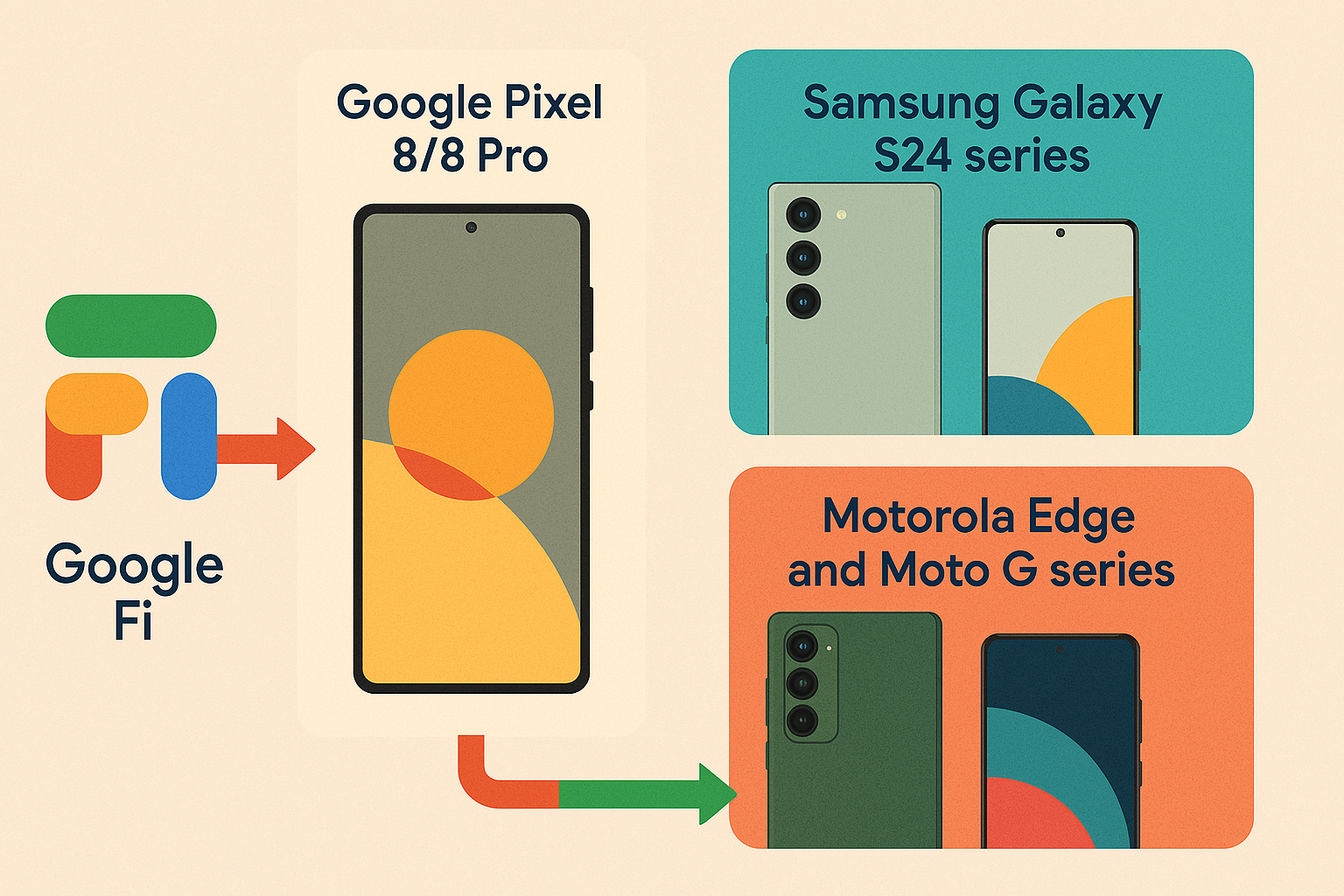
All phones purchased directly from Google Fi come unlocked, allowing you to switch carriers freely. However, for the best experience, it’s important to use a phone that’s compatible with Fi’s network—especially one designed for or certified by Fi.
The most compatible models include:
- Google Pixel 5 series and above
- Samsung Galaxy S21 series and above
- iPhone models (iPhone 12 and up work best)
- Motorola Edge and Moto G series
These devices fully support Fi’s smart network switching, 5G access, and calling features like VoLTE and Wi-Fi calling. While you can bring your own phone (BYOP), it must meet a few key requirements:
- It should support T-Mobile bands
- It must be unlocked
- It needs to work with VoLTE
Keep in mind, some BYOP devices may not support full 5G or calling features, so checking compatibility on the Google Fi site is essential. Fi also supports LTE-enabled smartwatches like select Samsung and Pixel Watch models at no extra cost—something rare among carriers.
If you use an iPhone, check out our blog for more tips and details tailored just for iPhone users. For the smoothest experience, stick to Fi-ready or Fi-certified phones. Your choice of device can make Google Fi feel like a top-tier service—without the top-tier price.
Supercharge your mobile business connectivity with Spenza — your MVNO, live in days.
Google Fi When You Travel
One big edge of Google Fi wireless is how well it works abroad. You don’t need to swap SIMs when you land. You just keep using your phone. Google Fi works in 200+ locations worldwide, including Japan, Europe, Canada, Mexico, and more. You can use:
- Mobile data
- Text
- Call home
Calls cost extra in most cases, but the rates are fair. Many users say the service is smooth overseas, which makes it a smart pick for remote work or digital nomads. Long-term users also love Fi’s call quality abroad. That’s a big win for people who travel often for work or pleasure.
What Real Users Think of Google Fi
There are mixed Google Fi reviews online. Most people like the simple plan. Some praise the clear bills, no surprise fees, and smooth coverage. Others say the app eats too much data and wish for more coverage in rural spots.
Some common praise:
- Clean billing
- No contracts
- Works overseas
- Free spam blocking + VPN
Some common gripes:
- The app uses too much data
- Slower speeds during peak times
- Less rural LTE than AT&T or Verizon
Still, most long-time Fi users stay because they trust it and because it just works, especially when abroad. And here’s a fun fact: many Fi users hold college degrees and live in urban zones. It’s a tech-savvy crowd.
Spenza Simplifies Telecom for IoT Teams and Aspiring MVNOs
Running an IoT firm or managing multiple devices means constantly tracking eSIMs, devices, plans, and expenses. That’s where Spenza comes in. As a lightweight MVNE (Mobile Virtual Network Enabler), Spenza not only simplifies eSIM management but can also help you launch your own MVNO—just like Google Fi.
If you’re curious about the process, check out this guide on launching an MVNO with Spenza, and for a breakdown of the costs involved, here’s a detailed post on MVNO launch costs.
With Spenza, you can:
- Sync eSIMs, plans, and devices across teams
- Bulk map devices and lines
- Monitor usage and cost across all operators
- Update plans or lines from one unified dashboard
Looking for real-world use cases?
For a closer look at how Google Fi works, explore our full case study.
Final Thoughts
Google Fi delivers on its promise—simple, flexible, and no-nonsense wireless service that works well for everyday users. It’s great for individuals who want affordable plans without contracts or hidden fees. But when you’re managing multiple devices, teams, or thinking bigger—like launching a similar service yourself—that’s where the real challenge begins.
Spenza steps in to bridge that gap. If you’re dreaming of starting your own MVNO like Google Fi, Spenza gives you the tools to do it—all from a single, streamlined platform.
FAQs
Get better business connectivity with Spenza — launch your MVNO in days. Book your free demo today!


