


Introduction: Your Communication Stack is Your New Headquarters
What defines a global enterprise in 2026? It is not the physical tower in a city skyline. Instead, the communication stack is the real headquarters. This digital stack connects employees, customers, and systems across the globe, powering every interaction.
Remote work has made this shift permanent. Around one-third of employees prefer to remain remote long-term, while businesses demand higher productivity and lower costs. At the same time, customers want instant omnichannel support. The result? Communication infrastructure is no longer back office, it is business critical.
But jargon clouds the picture. UCaaS, CPaaS, APIs, AI. Each sounds like a silver bullet. Leaders often struggle to decide where to invest. Without clarity, they risk fragmented systems, higher costs, and poor user experiences.
In this blog, we’ll explain the two main pillars, UCaaS and CPaaS, how UCaaS and CPaaS convergence is already changing enterprise workflows, and why AI and global connectivity define the future of enterprise communication.
The Two Pillars of Modern Communication (A 2026 Refresher)
The digital stack rests on two strong pillars. One serves the employee. The other serves the customer. Together, they frame the future.
What are UCaaS and CPaaS?
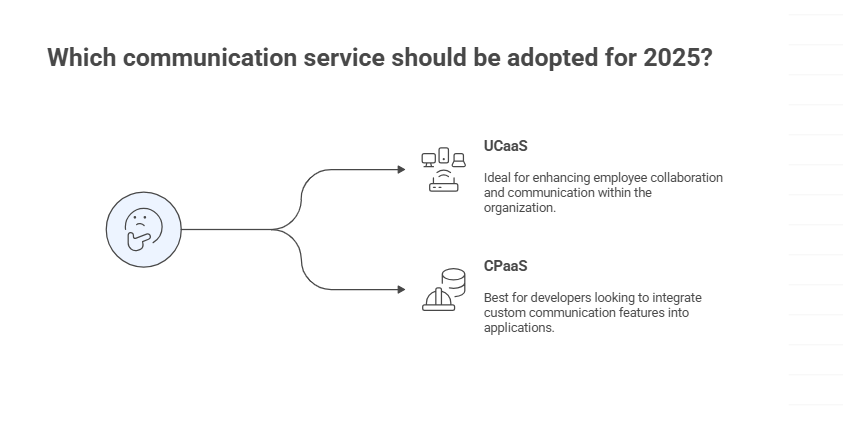
UCaaS (Unified Communications as a Service) is a cloud-based platform that brings together business communication tools such as voice, video meetings, messaging, and collaboration into a single application for employees.
CPaaS (Communications Platform as a Service) is a cloud platform that enables developers to embed communication capabilities like SMS, voice, video, email, and authentication directly into business applications using APIs.
Together, UCaaS supports internal collaboration, while CPaaS powers customer-facing communication. Modern enterprises increasingly combine both platforms with AI to create unified communication experiences.
UCaaS (Unified Communications as a Service): The Employee Hub
UCaaS is the digital workplace where teams connect and collaborate.
- UCaaS bundles chat, video conferencing, and VoIP into one cloud-based system.
- Employees get a single app instead of switching between multiple tools.
- For hybrid and remote teams, UCaaS is now the new office.
- By mid-decade, most enterprises run on cloud-first communication strategies..
The growth projections prove its importance. Analysts estimate UCaaS grows from tens of billions in 2026 to hundreds of billions by 2030, with annual expansion above 18%. In some forecasts, it surpasses $400 billion by 2034.
And adoption is no longer limited to large firms. SMBs are now the fastest-growing UCaaS buyers, with growth around 20% annually. They choose UCaaS because it removes heavy infrastructure costs and delivers enterprise-grade features as a subscription.
Even the way businesses manage telecom services is shifting. Many now use Telecom-as-a-Service (TaaS) to simplify deployment and billing. As explained in Telecom as a Service, this model ensures flexibility for modern enterprises.
UCaaS also evolves with intelligence. Built-in transcription, automated scheduling, and integrations make it more than a meeting app. It becomes the central hub of the future of enterprise communication.
But while UCaaS powers employees, it does not handle customer-facing workflows. That requires CPaaS.
CPaaS (Communications Platform as a Service): The Developer’s Toolkit
CPaaS embeds communication features into applications and customer touchpoints.
- CPaaS is API-first communication, not prebuilt apps.
- Developers integrate SMS, voice, video, and chat into business applications.
- Practical examples:
- Banks send OTP codes for security.
- Hospitals automate SMS appointment reminders.
- E-commerce adds in-app live chat or video support.
Adoption has surged. In 2023, half of enterprises already used CPaaS. By 2028, nearly all will adopt it. Market growth exceeds 25% CAGR and projects CPaaS to surpass $80 billion by 2030.
The drivers are clear: speed and flexibility. Developers no longer build telecom infrastructure from scratch. They plug in CPaaS APIs and go live in weeks.
CPaaS adoption is especially strong in Asia-Pacific, where mobile-first markets grow at 30% CAGR through 2034. Here, businesses skip legacy systems and move directly into API-first ecosystems.
This is why CPaaS is central to the future of enterprise communication. It is the engine behind customer engagement, while UCaaS remains the employee hub.
And CPaaS aligns with IoT strategies too. Enterprises already simplify device connectivity through IoT connectivity management, showing how programmable APIs can extend beyond messaging into connected devices.
The question now is not which one to choose, but how they come together.
The Great Convergence: When UCaaS and CPaaS Become One
Enterprises no longer tolerate silos. They demand convergence.
The most powerful enterprise communication trends 2026 are defined by UCaaS and CPaaS convergence. Businesses no longer want one system for internal chat and another for customer messaging. They expect unified experiences across employees, customers, and systems.
Examples illustrate the change:
- A customer service agent chats inside a UCaaS app. Instead of opening another platform, she sends a customer SMS directly via CPaaS.
- A CRM identifies a high-value customer issue. Automatically, CPaaS triggers an alert and UCaaS launches a video meeting with the support team.
This convergence solves the silo problem. It allows communication to flow without interruption between people and platforms. Customers gain omni-channel service. Employees see one interface. IT leaders cut cost and complexity.
By 2028, eight out of ten enterprises will embed AI into CPaaS workflows, linking them to UCaaS systems. That future blends programmability with collaboration.
And this shift is not just about tools. It is about user expectations. Customers expect instant contact. Employees expect frictionless collaboration. Leaders expect cost control. Convergence delivers all three.
This is why enterprises increasingly favor unified, API-first communication ecosystems that merge the best of both worlds.
Even in mobility, enterprises demand the same integration. Many build branded apps for employees and customers through platforms like Spenza’s branded mobile experience. These solutions extend the convergence story by tying communication into one seamless workflow.
But convergence alone is not enough. For the stack to work globally, it must rest on reliable, mobile-first connectivity.
UCaaS and CPaaS: A Quick Comparison
Before looking ahead, it helps to see how UCaaS and CPaaS stack up side by side.
| Aspect | UCaaS (Unified Communications as a Service) | CPaaS (Communications Platform as a Service) |
|---|---|---|
| Primary Use | Employee collaboration (chat, video, voice) | Embedding communication into apps (SMS, voice, APIs) |
| Target User | End-users, employees, hybrid teams | Developers, IT teams, app builders |
| Delivery | Prebuilt applications | API-first communication, programmable |
| Focus | Internal workflows and meetings | Customer-facing engagement and automation |
| Adoption Curve | Already mainstream across enterprises | Still growing rapidly, projected to near-universal adoption by 2028 |
| Growth Outlook | Expands into hundreds of billions by 2030 | Surpasses $80 billion by 2030 |
| Integration Potential | Becoming more API-friendly | Converging with UCaaS for unified platforms |
This comparison shows why UCaaS and CPaaS convergence is inevitable. One focuses on employees, the other on customers, but the future demands a single stack. That leads us into the forces shaping the next decade.
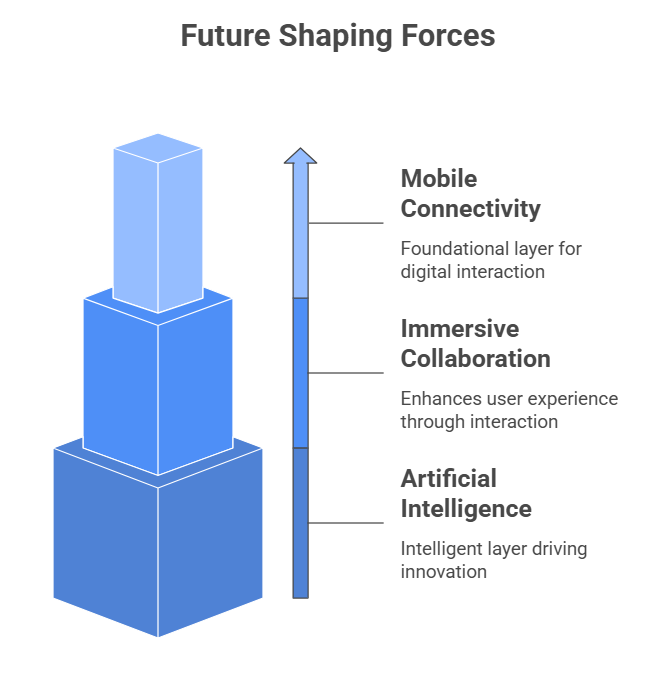
Beyond 2026: The Three Forces Shaping the Future
1. Artificial Intelligence (AI): The Intelligent Layer
AI in communication is no longer futuristic. It now acts as the intelligent layer in the future of enterprise communication.
- Real-time translation makes global meetings seamless.
- AI-powered meeting summaries remove manual note-taking.
- Smart routing ensures customer calls reach the right agent.
- Conversational AI bots handle routine support before human takeover.
This is more than automation. AI in communication reduces friction across workflows. By 2028, most enterprises expect AI features to be embedded by default into UCaaS and CPaaS platforms. That’s why enterprise communication trends 2026 emphasize AI-first adoption.
And AI is not only about calls or chats. It extends into predictive analytics for network usage, fraud detection, and IoT device management. That makes it the brain of modern communication stacks.
, But intelligence alone is not enough. People want richer, more engaging collaboration experiences.
2. Immersive Collaboration: The ‘Experience’ Layer
Immersive collaboration is the next frontier. Virtual reality and augmented reality shift communication beyond flat screens.
- Virtual training simulations make onboarding faster.
- AR-driven design reviews allow real-time collaboration across geographies.
- VR meetings create more presence than traditional video calls.
Forward-thinking enterprises already test these tools. Adoption is slower than AI because of hardware costs, but the momentum is clear. As networks improve, immersive collaboration becomes more natural and less gimmicky.
Even the way businesses think about alternatives is evolving. Many once relied on Skype or similar tools, but now search for Skype alternatives that integrate with immersive platforms.
The point is simple: collaboration must feel human, no matter where people work from.
However, both intelligence and immersion collapse if the foundation, connectivity, fails.
3. Mobile-First Connectivity: The Foundational Layer
All these tools require strong connectivity. Without reliable networks, UCaaS and CPaaS break down. That’s why the mobile-first communication strategy is the true foundation of the future of enterprise communication.
Distributed workforces need more than home Wi-Fi. They need enterprise-grade cellular coverage that works anywhere, urban centers, rural India, or moving across Europe. When Wi-Fi drops during a client call, business continuity suffers.
A mobile-first communication strategy solves this problem. Employees use cellular connections as primary or backup networks, ensuring uptime. Enterprises that adopt this approach improve both employee productivity and customer experience.
At the same time, managing all this connectivity requires smarter systems. Enterprises now turn to wireless connectivity management platforms to track usage, control costs, and enforce policies across global teams.
This is where Spenza enters, offering the resilient foundation that enables intelligence and collaboration to perform at scale.
Why Global Mobile Connectivity is the Foundation for the Future
The best UCaaS or CPaaS system fails if the underlying connection collapses. A remote employee’s Wi-Fi might drop in the middle of a critical sales pitch. A poor connection can turn a five-minute support chat into a frustrating 30-minute ordeal.
The Solution
A mobile-first communication strategy ensures always-on connectivity. With global eSIMs, employees connect securely to multiple carriers, reducing downtime. This flexibility gives IT leaders control while keeping teams productive anywhere in the world.
Spenza’s Role
Spenza provides this foundational layer for enterprises.
- With a global eSIM platform, teams stay connected across 190+ countries.
- Telecom-as-a-Service models simplify billing, provisioning, and scaling.
- IoT connectivity management simplifies scaling for connected products.
Beyond connectivity, Spenza also helps enterprises simplify complexity across the entire communication stack. From Telecom-as-a-Service models that modernize procurement, to wireless connectivity management tools that control costs across regions, Spenza brings everything into a single, cloud-native layer. This means IT leaders get real-time visibility, finance teams avoid billing surprises, and employees stay connected with zero friction.
By integrating services like MDM CMP integration and IoT connectivity management, Spenza ensures enterprises are not only future-ready but also cost-efficient today.
Spenza provides the dial tone for the future of enterprise communication. It ensures UCaaS, CPaaS, and AI systems remain online, secure, and reliable.
Building a Communication Strategy for Tomorrow
The future of enterprise communication is clear. It is integrated, intelligent, and mobile-first.
A winning strategy does not come from buying a single tool. It comes from building an ecosystem where UCaaS and CPaaS converge, AI adds intelligence, immersive tools enrich experiences, and global connectivity keeps everything online.
Spenza powers this ecosystem with resilient global mobile connectivity.
FAQs
Ready to build a resilient foundation for your enterprise communication stack? Contact Spenza to learn how our solutions can power your hybrid workforce.


