


Telecom operations become difficult to manage when billing, usage, provisioning, carrier data, and customer systems operate across disconnected platforms. TEM APIs address this problem by connecting these systems programmatically, allowing businesses to automate repetitive workflows, consolidate telecom data, and respond to operational changes faster.
The broader value of telecom APIs is also expanding. McKinsey estimates that network APIs could unlock approximately $100–300 billion in connectivity- and edge-computing-related revenue for operators over five to seven years, with an additional $10–30 billion from APIs themselves.
Keep reading to see how API platforms transform enterprises and foster new innovative ideas.
What are TEM API Platforms for Improving Enterprise Operations?
These platforms help companies manage Enterprise services. They integrate different services so they can work in unison. With these platforms, businesses can incur control expenses, manage networks, and employ several carriers from the same platform.
- Automates repetitive tasks
- Provides real-time network insights
- Supports multi-carrier connectivity
- Reduces human errors in billing
- Enhances security through encryption
- Helps Light MVNOs scale operations
- Prevents downtime with predictive analytics
What Is Telecom Expense Management (TEM) API?
Telecom Expense Management (TEM) APIs are programmatic interfaces that connect telecom expense, billing, usage, service, and operational data with enterprise systems, enabling businesses to automate workflows, manage telecom costs, and integrate multiple carriers and services.
How TEM APIs Improve Telecom Operations and Reduce Costs
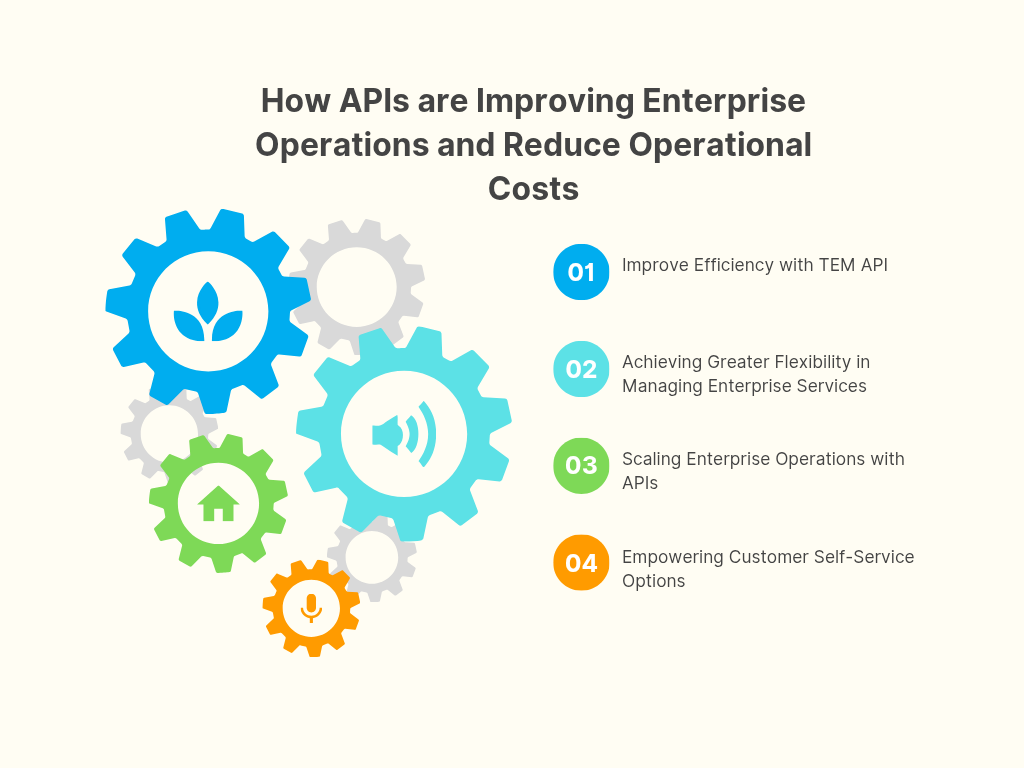
TEM APIs help telecom and enterprise teams connect carrier, billing, provisioning, usage, and service-management workflows. Instead of moving information manually between systems, APIs can automate data exchange and trigger actions based on defined business rules.
This is particularly useful when organizations manage multiple carriers, large device populations, recurring telecom expenses, or services that require frequent provisioning and changes.
Let’s break down exactly how.
1. Improve Efficiency with TEM API
APIs turn hours of work into seconds. For example, manually activating 10,000 SIM cards takes weeks. APIs do it in minutes. Teams, stop drowning in spreadsheets. They start solving bigger problems.
- Auto import invoices: Bulk import invoices
- Auto-activate devices: Bulk-process SIM activations for IoT deployments instantly.
- Sync billing data: Pull invoices from 50+ carriers into one dashboard automatically.
- Predict usage spikes: Machine learning flags overages before they cost you.
- Fix errors fast: APIs detect billing mistakes and trigger corrections in real-time.
- Assign tasks smarter: Route support tickets based on API alerts about device issues.
2. Achieving Greater Flexibility in Managing Enterprise Services
Customers demanded changes immediately, highlighting the need for swift adaptation. APIs empower businesses to quickly adjust, such as swapping carriers during outages or launching new plans overnight. Customizing portals for clients further enhances agility, which is crucial to staying competitive and avoiding the risk of losing business.
- Switch networks instantly: Move devices to backup carriers during downtime automatically.
- Test new pricing: Roll out regional data plans via APIs in hours, not months.
- White-label portals: Let clients manage devices with branded tools you build via APIs.
- Update services remotely: Push firmware updates to IoT sensors across 100 countries.
- Mix and match carriers: Combine AT&T, Vodafone, and Airtel plans without manual work.
3. Scaling Enterprise Operations with APIs
Growing from 1,000 to 1 million devices? APIs do the heavy lifting, eliminating the need for hiring sprees and avoiding chaos. For example, Spenza’s clients effortlessly double their device counts annually without any stress.
- Onboard fast: Add 50,000 SIMs via CSV uploads with automated carrier provisioning.
- Manage global rules: Apply data limits or roaming policies by country via APIs.
- Integrate new carriers: Plug in local operators in Brazil or Japan with pre-built code.
- Auto-scale capacity: Cloud APIs adjust server resources as device numbers climb.
- Cut onboarding time: Deploy new enterprise clients in 3 days, not 3 months.
4. Empowering Customer Self-Service Options
Customers hate waiting. APIs let them help themselves. Reset SIMs. Pay bills. Check usage. Your team gets fewer calls. Clients feel in control.
- DIY portals: Let users unlock devices, top-up data, or view invoices online.
- Usage alerts: Send SMS/email when customers hit 80% of data limits.
- API-driven analytics: Share live maps showing device locations and signal strength.
- Multi-user access: Customers grant permissions to vendors or IT teams via APIs.
- Feedback loops: Collect service ratings directly in portals to improve faster.
Why This Works Every Time
APIs remove friction. Manual tasks die. Costs drop. Customers stay. For example, a logistics company using Spenza’s APIs slashed device setup time by 91%. Another client cut billing errors by 73% in 6 months.
The secret? APIs don’t just “help.” They transform how enterprises operate. You stop reacting. You start controlling. Miss this shift, and rivals will outpace you. Adopt it, and you scale smarter.
Overcoming Challenges in API Implementation for Enterprise Operators
Implementing APIs in an enterprise comes with challenges. These issues need proper solutions.
| Challenge | Solution |
|---|---|
| Security risks | Use strong encryption and multi-factor authentication |
| Compatibility with old systems | Connect legacy systems using middleware |
| Network reliability issues | Use backup API endpoints |
| Compliance with enterprise laws | Follow industry regulations and standards |
| High setup costs | Choose cloud-based API solutions |
| Lack of skilled personnel | Partner with API management experts |
| Scaling concerns | Pick APIs designed for business growth |
Choosing the Right API-Based Management Platform for Your Enterprise Business
Picking the right API platform shapes your enterprise business’s future. A weak choice drains budgets. A strong one fuels growth. But how do you decide? Look for solutions that solve real problems—not just flashy features.
Spenza stands out here. Our platform connects you to 100+ global operators instantly. You customize voice, SMS, and data plans without coding. But that’s just the start.
Let’s break down what matters.
1. Global Carrier Access Without Headaches
Not all platforms support global carriers. Some lock you into regional partners. Leading solutions connect businesses to Tier-1 operators like Vodafone, AT&T, and Singtel. You add new carriers in hours, not months. Need coverage in Brazil next quarter? Establish local partnerships via API marketplaces. No lengthy contract negotiations or sales team delays.
2. Integrations That Work on Day One
APIs fail if they don’t mesh with your tools. Top solutions integrate with ERP systems, CRMs like Salesforce, and custom apps effortlessly. Automate invoicing by syncing carrier data with accounting software. Push device status updates to client portals via webhooks. No complex coding required.
3. Compliance Built for Strict Regulations
GDPR. CCPA. OFAC. Enterprise rules bury teams in paperwork. Advanced platforms auto-generate audit trails and compliance reports. APIs enforce data residency laws—EU SIM data stays in EU servers. Avoid fines with rules embedded directly into workflows.
4. The Wrong Choice Costs More Than Money
A bad API platform slows launches. It frustrates customers. It burns cash on fixes. Spenza removes these risks. Their tools adapt as you grow.
Still unsure? Compare platforms side-by-side. Check carrier coverage. Demand compliance proof. Ask for client references. Spenza wins on all fronts.
Final Thoughts
Enterprise operations using an API platform have experienced significant changes. Enterprises require these types of solutions because they cut operational costs, improve efficiency, and offer flexibility in managing Enterprises. Companies using API-based platforms enjoy simplicity and cost efficiency.
FAQs
Need assistance in making Enterprise management more efficient? Contact Spenza now. Our platform allows businesses to manage enterprise services, control costs, and monitor expenses with ease.


