


Given the economic uncertainties brought on by the COVID-19 epidemic, many organizations are analyzing spending to keep costs under control. However, one area of potentially considerable savings is frequently neglected or disregarded – the telephone bill.
Telecom expenditure management tools streamline the process of reviewing and monitoring telecom invoices. However, telecom billing problems are merely a symptom of a more significant issue. The more important question is whether your company has the correct combination of telecom services to satisfy its demands.
What Is Telecom Billing?
Telecom billing is the process of collecting usage, subscription, contract, and service data; applying rates, discounts, taxes, and fees; generating invoices; and reconciling billed amounts with network and financial records.
The Bill’s Components
Telecom invoices may be divided into numerous categories, revealing how much a corporation pays.
Non-recurring charges (NRC) are payments paid by the firm just once. These one-time fees are often associated with the purchase of a new device, including services such as installation and disconnection of prior circuits.
Monthly recurring charges (MRC) are telecom expenses that a business must pay monthly to continue utilizing a service. Organizations must pay for each connected circuit and almost certainly have a contract. These monthly expenditures include service and line rental charges for each inventory item, which should be consistent monthly. On the other hand, usage costs will fluctuate month to month depending on the quantity of data required and used. If the vendor offers managed services, this will be reflected in the bill.
Other costs, such as regulatory and pass-through fees, will be included in the bill. These will differ based on the circuit type and region.
Finally, taxes must be paid in addition to these fees. When the telecommunications bill is split down in this manner, it is much easier to understand. Despite this, the information a firm requires to pay and, more importantly, comprehend its bills isn’t always readily available due to how some invoices are given to clients.
Modern Telecom Billing: What to Check Beyond the Invoice
Modern telecom billing needs to validate more than whether an invoice was generated correctly. A billing operation should also verify:
- Usage-to-bill accuracy: Confirm that network usage and billable events are captured, rated, and billed correctly.
- Contract-to-bill accuracy: Compare contracted services, rates, discounts, and commitments with actual charges.
- Revenue assurance: Identify missing, duplicate, rejected, or incorrectly rated transactions before they become revenue leakage.
- Tax accuracy: Apply the correct tax rules based on customer location, service, and applicable exemptions.
- Billing reconciliation: Reconcile network, mediation, charging, billing, and financial-system records.
- Pricing and discount accuracy: Ensure promotions, bundles, and plan rules are applied consistently.
- Auditability: Maintain traceability from usage or service events through charging, invoicing, and financial records.
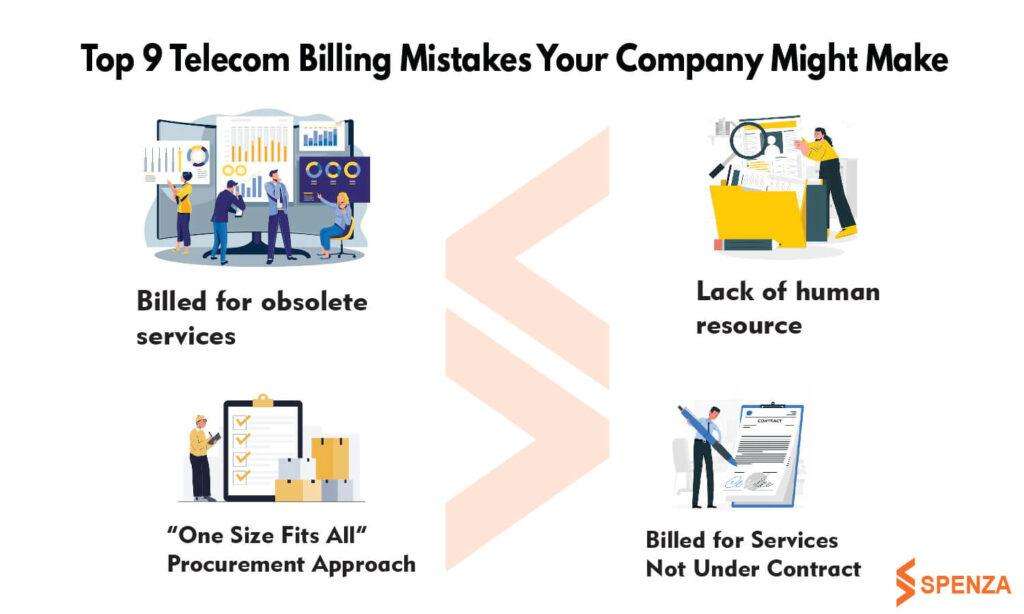
Top 9 Telecom Billing Mistakes Your Company Might Make
Telecom Billing Mistakes: How to Prevent Them
The most costly telecom billing problems usually occur when contracts, network usage, charging, billing, and financial records are not properly aligned. Preventive controls should therefore combine automated validation, reconciliation, clear permissions, and regular review of services, pricing, discounts, and usage data.
Here are the most typical telecom billing mistakes to avoid :
1. Lack of people
A lack of human power, technology functionality, and process management add to billing issues. For obvious reasons, billing departments that are understaffed frequently cause more difficulties than they solve. Smaller teams necessitate a more significant investment in user-friendly billing software that can automate operations and reduce workload. Furthermore, when consumers desire to update their B/OSS, they must appoint professional project managers to guarantee that the conversions proceed well. How else would their businesses reap the returns on investment for the increased capabilities provided by the systems?
2. Billed for Services that Have Become Obsolete
Old services become outdated when new and superior services become available, and outmoded services become exceedingly costly.
3. Tax Application
Incorrectly taxing or exempting customers are two pernicious risks to telecom billing accuracy. They are frequently caused by a lack of data in their present tax engine, the absence of an integrated tax engine, or the inability to engage in-house telecom tax service professionals specialized in billing methods. Furthermore, certain businesses may need to pay greater attention to address validations, which results in no local or county taxes being levied, even when state and federal taxes are levied.
4. Billed for Services Not Under Contract
Can you recall all the services you agreed to when you signed your telecom contract? The answer is no for many of us. If you’re unclear about what you decided to do, you could be paying for services that are no longer required.
5. Unapplied Discounts
Forgetting a promotional rate to a subscriber’s account may save a CSP money, but it may also lead the same CSP to lose consumers due to displeasure.
Retention is becoming as crucial in telecom as acquisition. With fierce price rivalry and market saturation, a high customer churn rate might imply that many customers were drawn to a CSP by low costs but were not adequately billed and took the problem personally. In truth, the problem might be as simple as a misconfiguration about overall consumption vs. local usage, which causes the discount to fail to register as intended.
6. Billed for Services on Outdated Plans
The telecom industry evolves so swiftly that plans become outdated in the blink of an eye. Your pricing will be out of date if your plan is out of date. If this is the case, you might be paying too much.
7. Unbilled Late Fees or Penalties
Companies can now increase their profits through late fees and penalties, but many lack the technology to do so successfully. Carriers unable to effectively charge fees are missing out on a critical income stream, the quantity of which will remain unclear in the absence of a comprehensive billing solution.
8. “One Size Fits All” Procurement Approach
Just because a plan works well for one client does not mean it is your ideal answer. It is a mistake to select the most popular plan if it does not meet your demands.
9. Permissive Permissions
More CSPs should spend time and effort properly determining what their reps can and cannot do within their systems. The smart telecom billing software enables department heads to provide strict authorization for crediting consumers. When permissions are correctly specified, staff no longer have free reign to take charges from subscriber accounts, causing the company to lose money.
What to Look for in Telecom Billing Software
When evaluating telecom billing software, look beyond invoice generation. The platform should support the complete billing and revenue lifecycle, including usage collection, rating and charging, discounts, taxation, reconciliation, revenue assurance, reporting, and integration with network and financial systems.
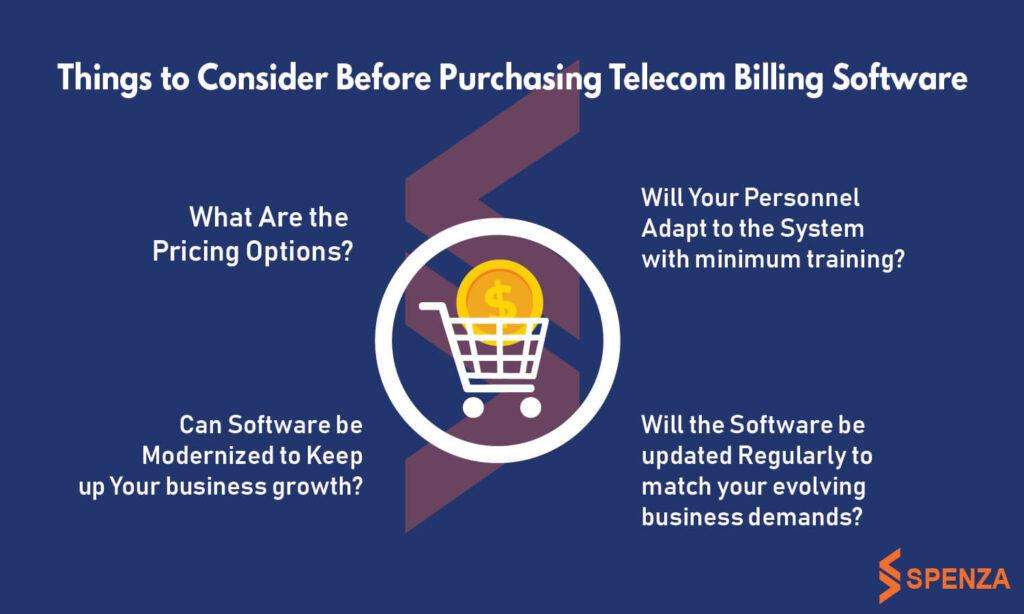
1. What Are the Telecom Billing Software Pricing Options?
There are often two price options for a telecom billing software system in the market. They are subscription-based and need a one-time license.
A one-time payment is required to purchase licenses and own the program permanently in a one-time arrangement. In a subscription-based business, you must buy it for a set period of time at a set fee.
Subscription-based pricing is excellent for cloud-based offers; on-premise solutions, on the other hand, are available with a one-time license strategy. You will need to purchase software updates and upgrades if you choose an on-premise option.
2. Will Your Personnel Adapt to the System with Minimum Training Swiftly?
A steep learning curve may require considerable time expenditures in training, resulting in a longer implementation time. Some providers also charge extra for training and installation.
3. Can Your Software Be Modernized to Keep Up Your Business’s Growth?
Sometimes you attain your company goals at breakneck speed, and your tools let you down by offering services at their own pace, causing your firm to stagnate. Your telecom invoicing software must adapt to the expansion of your organization, allowing you to grow more effectively.
4. Will the Software be Updated Regularly to Match Your Evolving Business Demands and the Most Recent Industry Regulations?
Will the software stay compatible even if your hardware is upgraded?
5. Telecom Billing Software Features
Telecom billing software should provide capabilities beyond invoice generation. Key features to evaluate include:
- Rating and charging: Apply usage, subscription, event, time, location, and product-specific pricing rules.
- Revenue assurance and reconciliation: Compare usage, charging, billing, and financial records to identify discrepancies and leakage.
- Tax management: Support applicable tax rules, exemptions, and geographic requirements.
- Discount and promotion management: Apply plan discounts, bundles, credits, and promotional pricing accurately.
- Multi-currency and multilingual support: Support customers, invoices, and commercial operations across different markets.
- Hierarchical billing: Support different account structures such as consumers, businesses, resellers, and enterprise accounts.
- Scalability and automation: Handle growing transaction volumes and automate repetitive billing and reconciliation processes.
- Integration: Connect with BSS/OSS, network, payment, CRM, ERP, and other operational systems.
Telecom Billing Software Buying Checklist
Before selecting a telecom billing platform, verify that it can:
- Process the required usage and billing volumes
- Support prepaid, postpaid, or hybrid billing models
- Handle complex tariffs, bundles, discounts, and promotions
- Reconcile usage through billing and financial systems
- Detect billing discrepancies and revenue leakage
- Support applicable tax and regulatory requirements
- Integrate with existing BSS/OSS and enterprise systems
- Provide audit trails and role-based permissions
- Scale as subscribers, services, and transaction volumes increase
- Support automation and near-real-time billing or charging where required.
Conclusion
Telecom billing accuracy depends on more than generating invoices. Telcos need to validate usage, contracts, pricing, taxes, discounts, charging, billing, and financial records throughout the revenue lifecycle. Modern billing software can automate these controls, improve reconciliation and revenue assurance, reduce manual work, and provide greater visibility into billing operations.


