


Executive Brief (for CEOs/CTOs/COOs/Busy founders & Product leaders)
The right MVNE in 2026 should let you launch your MVNO in days, support Bring Your Own Network (BYON) and a multi-operator marketplace, provide no-code + robust APIs, be eSIM-ready, and offer transparent, flexible pricing with US tax/KYC built in and a global compliance roadmap.
Spenza checks all boxes today and publishes a clear roadmap for what’s next.
Definition, in one line: An MVNO (mobile virtual network operator) sells mobile service over existing MNO networks without owning the radio access network; in the US, most new MVNOs launch via an MVNE to reduce time-to-market and upfront cost.
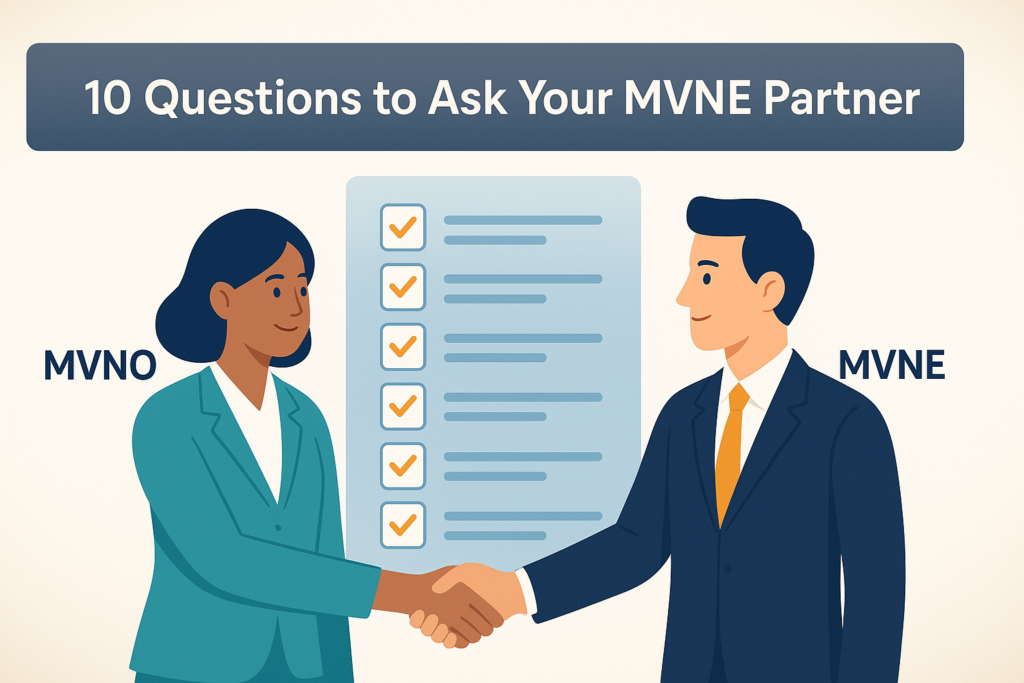
What Would You Get by the End of the Article?
- A clear understanding of the 10 most critical questions to ask any MVNE partner in 2026.
- Insight into why each question matters for your MVNO’s long-term success.
- A framework to evaluate and compare MVNE partners with measurable criteria.
- Knowledge of Spenza’s differentiators, including speed, no-code platform, multi-carrier access, and eSIM-readiness.
- Practical guidance on compliance, pricing transparency, and scalability.
- Real-world examples of MVNO success using multi-carrier and eSIM strategies.
- A checklist that doubles as a decision-making tool for partner shortlisting.
How to Use This Checklist
- Score each question 0–2 (0 = No/Weak, 1 = Partial, 2 = Yes/Strong).
- Weigh by importance (multiply by 1–3).
- Decide: shortlist partners ≥80% of your max weighted score.
How to Recognize a Strong MVNE Partner
A strong MVNE should provide:
- Multi-carrier flexibility through BYON or marketplace access
- Production-ready eSIM capabilities with future standards support
- Transparent pricing without restrictive lock-ins
- API-first architecture with no-code operational tools
- Built-in compliance, billing, and operational support
If a provider cannot clearly demonstrate these capabilities, expect higher operational complexity, slower launches, and increased long-term costs.
Decision Matrix(example)
| Requirement | Weight | Vendor A | Vendor B | Vendor C | Notes |
|---|---|---|---|---|---|
| Launch in days | 3 | 2 | 1 | 0 | Proven vs. “estimate” |
| BYON + Marketplace | 3 | 2 | 1 | 1 | Contracting + speed |
| eSIM readiness (incl. SGP.32 roadmap) | 3 | 2 | 1 | 1 | Standards clarity |
| US tax + KYC built-in | 2 | 2 | 1 | 0 | Immediate compliance |
| Transparent pricing (tiers, no lock-ins) | 3 | 2 | 1 | 1 | Gotchas avoided |
| No-code + APIs + Shopify | 2 | 2 | 2 | 1 | Ops velocity |
Now, with the weighted criteria in mind, let’s look at the key questions to ask an MVNE when launching an MVNO in 2026.
Top 10 Questions to Ask Your MVNE Partner
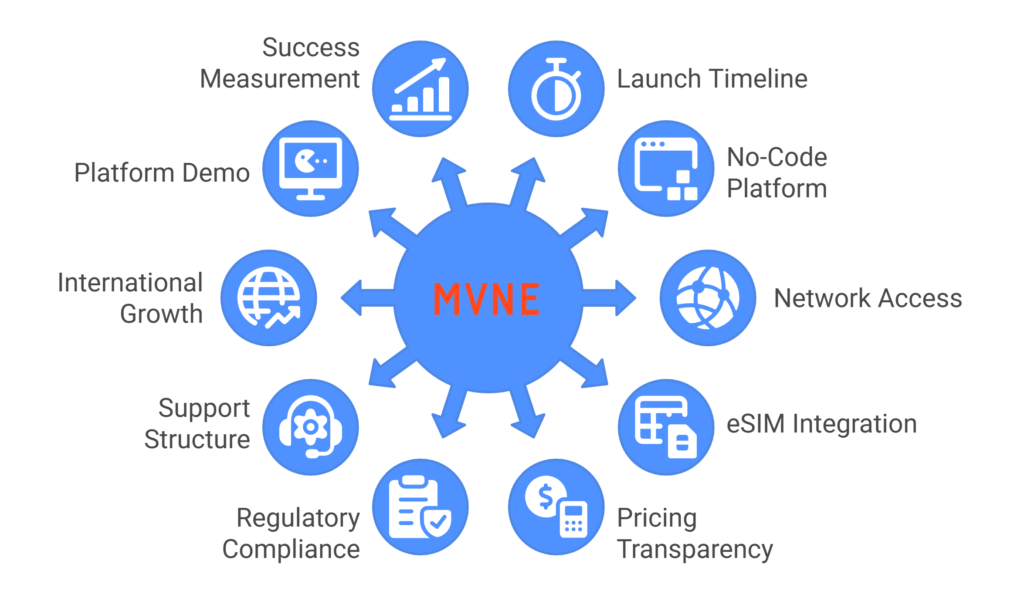
1) Strategy First: BYON + Marketplace
What to ask
- Can we bring our own carrier agreements (BYON) and still manage everything in one pane of glass?
- If we don’t have contracts, can we go live via your multi-operator marketplace in days—not months?
Why it matters
BYON maximizes control and cost leverage; marketplace gives you instant coverage and time-to-market. The best MVNEs support both, so you can optimize by country/device segment as you scale.
Spenza supports Spenza Marketplace & BYON to add new coverage quickly and grow with ease.
2) Network & Coverage Readiness
What to ask
- Which Tier-1 MNOs do you have direct deals with? How strong are those partnerships?
- Can you show QoS/QCI transparency, VoLTE defaults, 5G SA/NSA roadmap?
- Evidence: roaming footprint maps, sample SLAs, escalation matrix with MNOs.
Why it matters
Your MVNO’s experience equals the quality of the host networks and your MVNE’s leverage with them. Probe for direct Tier-1 ties and SLA-backed escalation paths.
3) eSIM & Device Readiness
What to ask
- Do you support SM-DP+/SM-DS flows and in-app activation UX?
- Can you demonstrate activation success rate and time-to-first-packet?
- What’s your roadmap for SGP.32 (next-gen eSIM for devices)?
Reality check
You’ll need today’s eSIM orchestration and tomorrow’s standards. Spenza orchestrates eSIM to minimize SKUs and has SGP.32 on its roadmap.
4) APIs, No-Code, and Integration Depth
What to ask
- Is there API parity for provision/swap/suspend/plan changes, webhooks, and audit trails?
- Is there a no-code layer for non-technical teams and Shopify integration for direct commerce?
Why it matters
APIs drive automation; no-code accelerates launch and ops. Spenza provides a no-code MVNE platform + integrated Shopify app for fast execution.
Check out Spenza’s detailed API documentation: https://api.preprod.spenza.com/
5) Billing & Monetization Architecture
What to ask
- How do you support prepaid/postpaid, add-ons, shared pools, promos?
- Do you provide CDR rating & billing (or is it on your roadmap)?
- Can we export data to BI/finance and reconcile cleanly?
Spenza status
CDR rating & billing is on Spenza’s near-term roadmap; the current platform supports unified connectivity management and integrated billing.
6) Compliance, Tax, and KYC/eKYC
What to ask
- Which telecom taxes and regulatory filings do you handle vs. what do we handle?
- Do you support KYC/eKYC, GDPR/CCPA, and lawful intercept hooks?
- What’s your global compliance roadmap?
Spenza approach
Spenza includes US telecom tax integrations and supports KYC/eKYC, with global compliance as a declared roadmap. Expect pre-integrated tax/regulatory workflows and SOC progress for trust.
Pro tip: Ask every MVNE to list, in writing, which regulatory filings they perform as your agent and what indemnities apply if they miss.
7) Operations, SLAs, and Support Velocity
What to ask
- 24/7 support? Response/Resolution SLAs? Escalation matrix to MNO?
- Training for your staff and an agent portal that solves first-contact issues?
- Inventory, eSIM/SIM/device tools, and analytics dashboards out of the box?
Why it matters
Weak MVNE–MNO escalation = delayed fixes and churn. Demand contractual SLAs and tooling that shortens time-to-resolution.
8) Pricing & Commercial Clarity (Avoid the Gotchas)
What to ask
- Full breakdown of setup, recurring, and usage-based fees; minimums and volume tiers?
- Any activation fees, roaming mark-ups, or penalties? Exit/migration terms?
Why it matters
Opaque pricing erodes margins. You need volume-tier clarity and flexibility—especially early on.
Spenza stance: Transparent fees, volume-based tiers, low upfront setup, and no long-term lock-ins. (Low setup and tiered model referenced in internal pricing notes.)
Learn more about MVNO billing platforms: /mvno/mvno-billing-platforms/
9) Security & Reliability
What to ask
- Is the platform HA with geo-redundancy? What are RTO/RPO targets?
- Failover for HSS/BSS/APIs? Incident communication protocols?
Why it matters
You need documented architecture and DR objectives to safeguard revenue and reputation.
10) Analytics & Reporting
What to ask
- Do you provide dashboards (activation success, churn, ARPU, usage) and raw exports?
- Alerts and anomaly detection for fraud/abuse?
Why it matters
Fast insights power pricing, promos, and cost control.
The Spenza Advantage
Launching an MVNO can seem daunting, but Spenza was built to turn this complex process into a simple, streamlined path to market. We embody the principles of a true strategic partner, providing not just a platform, but an entire ecosystem for your success.
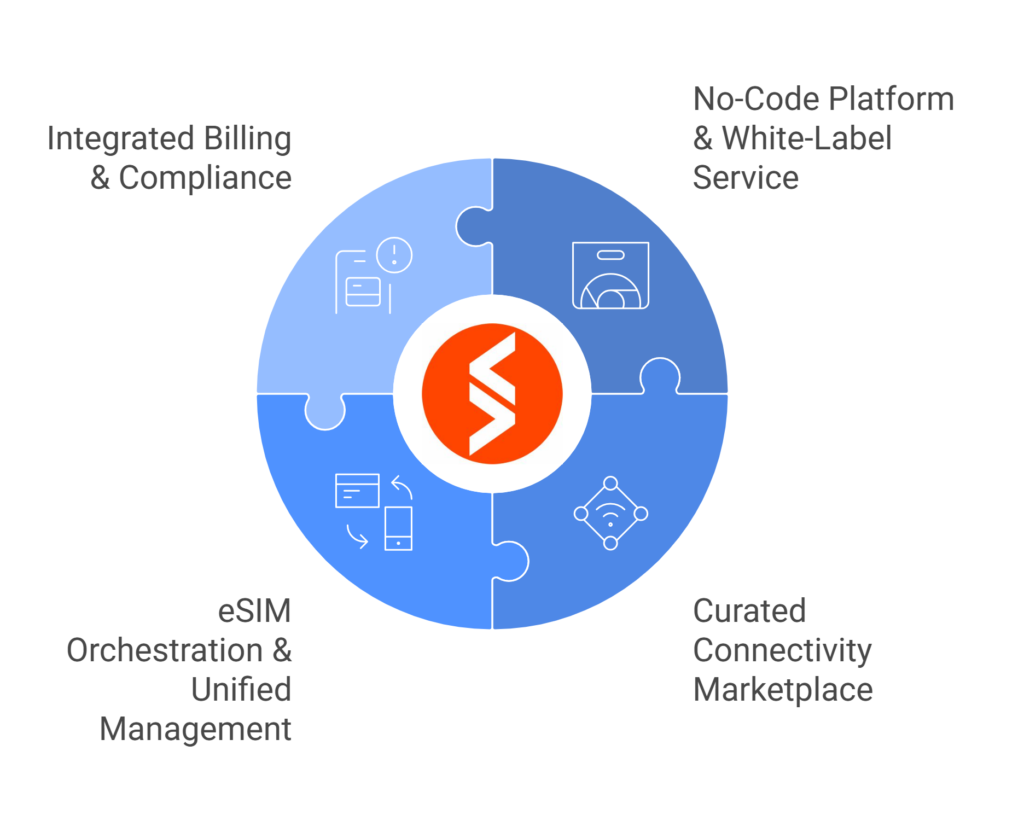
- No-Code Platform & White-Label Service: Our experts provide end-to-end guidance, from discovery to deployment. With our pre-integrated no-code MVNE and Shopify app, you can create a fully branded online store and launch in as little as 7 days, not months.
- Curated Connectivity Marketplace: Forget lengthy and expensive contract negotiations. Instantly access and resell a range of “fit-for-purpose” connectivity plans from multiple operators, ensuring you have the perfect offering for your niche from day one.
- eSIM Orchestration & Unified Management: Avoid SIM fragmentation and logistical nightmares. Manage your entire operation—ordering, activating, and managing eSIMs for all your customers—from a single pane of glass.
- Integrated Billing & Compliance: We handle the boring, complex, but critical stuff. Our platform automates billing, payments, and tax remittance. We help you stay compliant with global tax and telecom regulations so you can scale with confidence and avoid the risk of fines or shutdowns.
Why Spenza wins executive checkpoints
| Requirement | Spenza (Now) | Spenza (Roadmap) |
|---|---|---|
| Speed to Market | Launch in just 7 days using no-code tools and Shopify integration. | Expanding integrations for faster onboarding and broader capabilities. |
| No-code + APIs | No-code MVNE platform with robust APIs; includes Shopify integration. | Expanding API capabilities for deeper feature parity across systems. |
| Multi-carrier Access | Unified marketplace plus Bring Your Own Network (BYON) in a single interface. | Expanded operator catalog for increased global coverage. |
| eSIM-readiness | eSIM orchestration designed to minimize SKU complexity. | Support for SGP.32 to enable next-generation device compatibility. |
| Compliance | Pre-integrated US telecom taxes and filings; KYC/eKYC processes; SOC compliance in progress. | The roadmap includes global compliance coverage. |
| Monetization | Unified management with integrated billing for consumer IoT. | CDR rating and billing, plus inventory automation from purchase to deployment and peer-to-peer testing. |
| Commercials | Transparent fees, volume-based tiers, low setup costs, and no long-term lock-ins. | Ongoing optimization of pricing tiers. |
No lock-ins: Spenza promotes flexibility as part of its commercial stance for 2026 buyers.
Real-world outcomes
Case Study: The Power of Multi-Carrier Support
Angel Watch, a company providing smartwatches for children, resells mobile plans in both the US and the UK. For their product, reliability isn’t just a feature—it’s a promise of safety and peace of mind for parents.
By leveraging Spenza’s multi-carrier relationships, Angel Watch can ensure their devices have reliable connectivity across different regions, and they can manage all their subscribers through one platform, even when they are on different underlying networks.
Mini Case Study: Connectivity for IoT

Consider a company like Butlr, which develops IoT sensors for home automation. Their devices require reliable, high-bandwidth mobile plans across multiple countries, including the US, UK, France, and Germany. A traditional MNO would require separate, complex, and expensive negotiations for each region.
By partnering with Spenza’s platform, Butlr can procure custom plans for all its markets, manage all services, and pay a single bill through one unified dashboard, dramatically simplifying its operations and enabling faster global expansion.
Conclusion: Choose a Partner, Not Just a Provider
Selecting an MVNE is a board-level decision. Asking these tough questions upfront will save you immense pain later. Your MVNE shouldn’t just be a software vendor; they should be a vested partner in your long-term success.
Demand evidence: MVNO launch plan, BYON + Marketplace, no-code + APIs, eSIM now/SGP.32 next, US tax + KYC now/global roadmap, MNO-backed SLAs, and transparent pricing. Spenza is engineered to meet these standards and show you the proof.
Launch MVNO in 7 Days with Spenza: /contact-us/
FAQs
Stop waiting. Start launching. Schedule a free demo today and we’ll build your personalized 7-day MVNO launch blueprint with you.


